






Showing posts with label two and a half bites. Show all posts

Sunday, August 5, 2012

Jane and the Damned by Janet Mullany

Published September 28, 2010.

Author website.

Jane Austen 

Novelist . . . gentlewoman . . . Damned, Fanged, and Dangerous to know. 

Aspiring writer Jane Austen knows that respectable young ladies like herself are supposed to shun the Damned--the beautiful, fashionable, exquisitely seductive vampires who are all the rage in Georgian England in 1797. So when an innocent (she believes) flirtation results in her being turned--by an absolute cad of a bloodsucker--she acquiesces to her family's wishes and departs for Bath to take the waters, the only known cure. 

But what she encounters there is completely unexpected: perilous jealousies and further betrayals, a new friendship and a possible love. Yet all that must be put aside when the warring French invade unsuspecting Bath--and the streets run red with good English blood. Suddenly only the staunchly British Damned can defend the nation they love . . . with Jane Austen leading the charge at the battle's forefront.  (goodreads.com)

I was a little apprehensive to read JANE AND THE DAMNED after my failed attempt at EMMA AND THE VAMPIRES.  One, I hadn't read the blurb in a while so I was under the impression that it was a JANE EYRE remake and two, I haven't been thrilled with the writing style of books set in this era so it was setting itself up to fail for me.  It ultimately didn't and I enjoyed the plot but it had its faults and a lot of that hinged on the writing itself.

I didn't know why this story was about Jane Austen.  You'd think there'd be some kind of relevance to it but it rightly could have been some made-up character created strictly for the book and it wouldn't have made a bit of different.  So I was haunted by the question, "Why the hell is this Jane Austen?" throughout, making it a touch distracting.

That's not to say I didn't like Jane.  I did.  She was a very strong woman that, although reluctantly, embraced her vampirism and used it to fight the French when they invaded (a point to be dealt with in a moment).  She stood her own as a fighter and even as her fellow Damned looked down upon her as not only a fledgling but an orphaned one (her maker having abandoned her and she was adopted by another) she stood tall, pulling off feats that eventually made them proud.

The writing didn't really lend itself to telling the story well, though.  I felt the progression was jerky and I often found myself shoved out of the story due to a ragged transition from one scene to the next.  The language was trying a bit too hard and while I never found it stilted it lent to the crappy transitions that kept pulling me out of the story.

That's not to mention that as I was reading I had a niggling feeling that Napoleon's army invading Britain just didn't sound right.  Did it make for some good drama?  Of course.  Jane wouldn't have been able to become the fighter she did without someone to fight so steadfastly against.  But it didn't seem right.  Love the interwebs as it verified my unsettled thoughts: Napoleon was never actually able to get past the Royal Navy to fight on British land.  Talk about taking gross liberties with history to serve the plot.  It only puffs up the question as to why it had to be Jane Austen as the lead in this story.  I have a big problem with that.  Adding vampires to Jane Austen's life is one thing.  I was entertained by all of that.  But why bastardize history so much?  I don't get it.  Wait, I do get it: it served the plot.  And yes, this book is a work of fiction.  But holy crap Napoleon's army never invaded Bath nor took London.  It's a contrivance of epic proportions that I still just don't understand.  Too many questions and not enough answers.

I did finish JANE AND THE DAMNED, much to my surprise.  I enjoyed it and I ultimately came to like Jane and Luke together but Jane is a little too bi-polar for me.  She changed her mind about accepting her vampirism as often as she changed dresses and it was rough going trying to keep track of where her brain was in terms of not only her vampirism but her love of Luke.  It wavered too much for my liking.  She turned out to be a really strong heroine in terms of fighting capabilities and standing on her own but she ultimately had too much negative about her that, for the most part, cancelled it out.

I was entertained so the book served its purpose in that regard but it's incredibly historically inaccurate, I still have no idea why Jane Austen was the focusing character and the writing leaves a bit to be desired.  If you're looking for a light, entertaining read reminiscent of Austenian works with a bit more fangs and blood and don't have much else to read JANE AND THE DAMNED will probably whet your appetite.  Just don't expect it to do much else.


Ban Factor: High - Vampires and they're shown as hedonistically as possible to make it all the worse.  But our dear Jane has arguments with conscience that might appease the banners, however slightly.

Monday, July 9, 2012

Chrysanthe by Yves Meynard

Published March 13, 2012.

Author website.

Christine, the princess and heir to the real world of Chrysanthe, is kidnapped as a small child by a powerful magician and exiled in a Made World that is a version of our present reality. In exile, supervised by her strict "uncle"(actually a wizard in disguise), she undergoes bogus memory recovery therapy, through which she is forced to remember childhood rape and abuse by her parents and others. She is terribly stunted emotionally by this terrifying plot, but at seventeen discovers it is all a lie. Christine escapes with a rescuer, Sir Quentin, a knight from Chrysanthe, in a thrilling chase across realities.


Once home, the magical standoff caused by her exile is broken, and a war begins, in spite of the best efforts of her father, the king, and his wizard, Melogian. And that war, which takes up nearly the last third of the work, is a marvel of magical invention and terror, a battle between good and evil forces that resounds with echoes of the great battles of fantasy literature.  (goodreads.com)

You know, for such an incredibly long book CHRYSANTHE was so unbelievably forgettable.  Just a note on the sheer length: my copy is roughly 500 pages with microscopic font and margins that are maybe 3/4 of an inch.  Look -


The majority of the books I read are half that, usually creating a longer than required book but it reads quickly.  Except this book wasn't shortened by it's tiny writing.  Extend it out to regular reading font and margins and you're looking at something that could possibly be broaching a 700 page book with no page breaks for chapters.  They start a couple of lines down from the end of the former chapter.  Only "book breaks" are allotted and there are seven "books" within this one.  If CHRYSANTHE were actually parsed out into seven bound books it 1) wouldn't have taken me a month to read because 2) I wouldn't have read past the first book.

As it stands CHRYSANTHE is a strange one for me.  I had neither the desire to stop reading nor continue.  I wasn't engrossed with the story and the characters were wafer thing with Christine barely developing beyond the first few pages.  Forget about Quentin.  That boy's a lost cause.  So I have no idea what compelled me to actually finish this title.  It goes against all of the logic of my prior DNFs as it rightly should have been one.

In all honesty I do think it was the world.  If nothing else the world was a pretty solid one and I found Quentin's and Christine's travels through the worlds to be fascinating and the concept that they're not even real once you leave them pretty intriguing.  It kind of bodes for the whole "tree falls in the forest" thing.  If no one's there to experience it does it exist after all?  I wasn't too fond of the whole Hero concept in that if there's an incompetent ass on the throne then the Book (read: bible) will spit out a Hero to depose the crappy ruler and not much can be done because the Law (basically an intangible governing entity enforced by some kind of higher power) will kill you dead if you even so much as flick a royal's nose and mean the harm it causes.  For instance Christine, at around 10 years old, got into a fight with a schoolmate in the made world where she was trapped and the girl kicked her in the shin.  Because the Law followed Christine and applied in the made world the girl died a horrible death (which varies from death to death on the method).  Neat concept, kind of crappy attribution.  There are a lot of flaws in the world's logic but it painted a nice picture regardless.

Except for the poop.  There's a lot of it.  Literally.  The author had an unhealthy obsession of demonstrating a character's ability to provide a BM.  I have no idea why.  But there was a lot of gut rumbling and voiding of bowels going on.  Is this an aspect of fantasy I just wasn't aware of?

CHRYSANTHE was one of the few books where I read reviews as I was reading it simply because I wanted to know why it kept getting such low star ratings.  Having read it I can understand.  You're pretty much only going to tolerate it if you're a world whore like I am, and even that's a stretch.  Reading it you're pretty much skating on the surface, reading a text book account of what's going on in these people's lives.  There's very little by the way of character development and I believe only Christine does any developing at all.  Barely.  Having such vicious false memories implanted can have one hell of an effect on a person's psyche and if I said Christine didn't grow at all as a character I'd be lying but she doesn't grow much.  She is rather stunted in the maturity department and she does end up with a lot shoved into her lap and I do believe she reacts accordingly.  But since everything else around her is stagnant and the time elapsed is only a matter of weeks it doesn't help her.  I think she's come a long way in a short amount of time, all things considered, but it's contextual.

I feel like reading something so incredibly dense I should have taken more away from it but it's fluid; it just runs from my mind.  There isn't much that's all that memorable about CHRYSANTHE but it's not inherently bad either.  I think if the author had a bit more focus and honed in on a single character or two instead of resorting to the third person omniscient voice I think more could have been done in terms of character development, especially for Christine.  It's supposed to be mostly her story but once she gets to Chrysanthe she'd abandoned for other corners of the world most of the time.  It's unfortunate.

I think the premise was fantastic and it had potential but the execution was lackluster at best.  I really wanted to like CHRYSANTHE but it just fell flat.


Ban Factor: High - It has a "made" world where everything is fake, including a bastardized version of Christianity which Christine ends up abandoning for the "true" religion of Chrysanthe.  No, no, the banners won't like that.

Sunday, May 13, 2012

The Unidentified by Rae Mariz

Published October 5, 2010.

Author website.

Kid knows her school’s corporate sponsors not-so-secretly monitor her friendships and activities for market research. It’s all a part of the Game; the alternative education system designed to use the addictive kick from video games to encourage academic learning. Everyday, a captive audience of students ages 13-17 enter the nationwide chain store-like Game locations to play. 


 When a group calling themselves The Unidentified simulates a suicide to protest the power structure of their school, Kid’s investigation into their pranks attracts unwanted attention from the sponsors. As Kid finds out she doesn't have rights to her ideas, her privacy, or identity, she and her friends look for a way to revolt in a place where all acts of rebellion are just spun into the next new ad campaign.  (goodreads.com)

You know, THE UNIDENTIFIED had a good premise but the overall execution ended up being rather ho hum for me.  At the end of the day it was about the social outcast coming to grips with the social strata in her school with the end result being the nonconformists conforming to the nonconformists' conformity.  I was actually kind of disappointed.  I'm not really sure what I was expecting but I know it was definitely something a little more than a higher tech Heathers (which is an awesome movie, THE UNIDENTIFIED, not so awesome of a book).

Kid is your standard I DON'T WANT TO FIT IN chick that purposely goes out of her way to not blend in with the crowd.  Too bad for her that has the adverse effect and her nonconformist attitude gets picked up by the mall/school sponsors as the new uncool cool.  Really, a bit on the lame side.  The anti-popular popular.  Kid then gets branded and her best friend totally hates her for it because BEST FRIEND has been trying soooooooooo hard to get branded (aka sponsorship and free stuff with access to a VIP lounge) whereas Kid obviously bucked the system.  A boy gets involved that equally contributes to the screwing up of things because her other best friend, Ducky Mikey, totally digs her but, of course, doesn't say anything until it's too late and then holds it against her.  Brilliant.

Kid makes an effort to seek out The Unidentified, whom I originally thought to be this epic paramilitary group that could exist in Red Dawn or something but it turns out they're just the school freaks with weird hair that buck the system even more than Kid.  More disappointment.  I saw The Unidentified "twist" coming almost as soon as it entered simply because it played out exactly as what it was.  But whatever.

The more I write about THE UNIDENTIFIED the more annoyed by it I become.  For a book that plays at being covert and espionage-ish is ended up being completely dull and nothing more than your standard high school fare set in a slightly futuristic mall setting with some video games for classes.  The world itself was probably the most unique part of the story: the government ran out of money for education so it started being subsidized by private companies and the whole system ended up being one giant ad campaign with students vying to be each company's number one star.  It's also a world with a lot of anti-kid laws like curfews, a lack of regard for the first amendment where kids aren't allowed to congregate anywhere, walk anywhere, simply because they may cause trouble.  But that latter part isn't touched on too much.  Kid doesn't really go out into the world but once and it's intricacies are off-handedly mentioned as she looks for people.  The story world is pretty strictly confined to the mall.  But outside of that, it's the same story repeated ad infinitum.  There was nothing about that aspect that stood out to me.

In my opinion file this one into the copycat category.  Not really dystopian simply because the world isn't anywhere near built up enough to grasp onto that genre but it's slightly unsettling.  Education going into the private corporation sector for funding is slightly horrifying.  But the story itself is a rehash, playing out like yet another teen movie with this epic We Are The Teen World ending and not much standing it out against the rest.


Ban Factor: Medium - There's swearing and sexual references going on but one would actually need to READ the book in order to find them. That's a non-issue for banners so that alone should make it slide right under their radar.  Maybe.

Monday, April 30, 2012

The Disunited States of America by Harry Turtledove

Published September 6, 2006.

Author website.

Justin's family are Time Traders. The summer before he's due to start college, he goes with them to a different Virginia, in a timeline where the American states never became a single country, and American history has consisted of a series of small wars. Despite his unease, he accompanies Randolph Brooks, another Time Trader, on a visit to the tiny upland town of Elizabeth, Virginia. He'll only be away from his parents for a few days.

Beckie Royer thanks her stars that she's from California, the most prosperous and advanced country in North America. But just now she's in Virginia with her grandmother, who wants to revisit the tiny mountain town where she grew up. The only interesting thing there is a boy named Justin--and he'll be gone soon.

Then war between Virginia and Ohio breaks out anew. Ohio sets a tailored virus loose on Virginia. Virginia swiftly imposes a quarantine, trapping Becky and Justin and Randolph Brooks in Elizabeth. Even Crosstime Traffic can't help. All the three of them can do is watch as plague and violence take over the town.

It's nothing new in history, not in this timeline or any other. It's part of the human condition. And just now, this part of the human condition sucks.  (goodreads.com)

This is actually the fourth book in the CROSSTIME TRAFFIC series but I didn't know that when I took the book on for review.  No worries though since it read pretty much as a standalone.  I'm going to take a leaping guess here and assume that book one actually explains the whole concept of crosstime traffic and why Justin's home timeline thinks they're the only ones special enough to be able to travel across time.  That whole concept just read really wrong to me.  That only Justin's timeline had those capabilities and they kept altering other timelines for the "good" of that timeline, and to prevent them from traveling across time, again for the "greater good."  Talk about playing god.  This is where I might be missing something from other books and since the whys aren't explained in THE DISUNITED STATES OF AMERICA I'm kind of left wanting in that area.  But my bad for picking up a series at book four.

As for the story within the greater CROSSTIME TRAFFIC story, it was, meh, okay.  The voice did little for me as it was more omniscient and a bit schizophrenic at times.  Becky's voice especially, in my opinion, kept changing and she would say things, like little sayings, that just didn't seem genuine to her character.  It was kind of jarring.  Justin was pretty constant in voice and development which leads me to believe that the author might have had a better time writing in either limited third or first via Justin as opposed to omniscient third.  It just didn't really work out too well when he was in Becky's voice.  The phrases were a little too kitschy and a lot of the times she sounded like what the author probably thought a teenage girl from California sounded like, in 1966.  She was just really artificial in her structure to me.

The story itself passed by in a blur and I found myself skimming a lot.  There was a lot of thinly veiled moralizing going on about inequality and "what if's" that I was kind of over it.  I'm really not into fiction for morals so when I have one pressed at me I tend to zone out.  The author also seemed to be really pushing the backstory of this particular timeline just as much as he was trying to push the story forward.  There were a lot of info burps going on that were creating the cornerstone for this particular world and they always seemed to happen when there was a lull in the plot, which was often.

Not much really happened to the characters until the end of the story.  The invasion itself didn't happen until at least two thirds of the way through and up until then it was a lot of talks in the back yard (seriously, every time Justin and Becky got together it was clunky storytelling in the backyard with fizzes, aka soda) and stuff happening on TV and the radio but nowhere near.  And it doesn't play out like what the blurb, I think, insinuates.  Or even by what the cover would intone.  Once the fecal matter smacks against the rotating device Justin and Becky's paths deviate and they get where they need to go on their own.  So the package was a bit deceptive because there wasn't much of a collaborative effort on their part.

All the blurbs in the book were raving about how awesome of an alt-history writer Turtledove is but what I saw was a really scattered plot, a piecemeal world and awkward writing, more often than not telling instead of showing.  I felt relatively little for any of the characters and really the only redeeming part for me was when Justin had to step into the shoes of a soldier in order to get to his destination.  That was really the only instance of suspense and true action I felt in the entire book.  That was the only place where I actually got to SEE Justin as more than the author's puppet.  Everything else was just yak, yak, yak and complain and coins.  It felt empty.

I do like how it's a different take on the whole dystopian front.  You know, instead of being an actual dystopian it's an alt-history that thus alters the present and future.  It's a breath of fresh air in that regard. But outside of that I was unimpressed.  Maybe if I'd started the series from the beginning I'd feel differently, with more background information on the home timeline and Justin's world but I'm really not sure how good that would do.  I seem to have the most problems with the author's writing style.  A bit harder to change.

Read THE DISUNITED STATES OF AMERICA if you're looking for something different than the standard dystopians out there.  It really is a good break in that regard.  Just be cognizant of the writing.  It's not all that phenomenal.


Ban Factor: Low - It's actually a pretty innocuous story.  Not much swearing, not much violence (considering) and barely any romance.  I don't know what the banners could get offended by here.  I mean, there are Christian god references and everything!  And not mocking!

Thursday, February 2, 2012

The Butterfly Clues by Kate Ellison

Pub date: February 4, 2012.

Author website.

Penelope (Lo) Marin has always loved to collect beautiful things. Her dad's consulting job means she's grown up moving from one rundown city to the next, and she's learned to cope by collecting (sometimes even stealing) quirky trinkets and souvenirs in each new place--possessions that allow her to feel at least some semblance of home.

But in the year since her brother Oren's death, Lo's hoarding has blossomed into a full-blown, potentially dangerous obsession. She discovers a beautiful, antique butterfly pendant during a routine scour at a weekend flea market, and recognizes it as having been stolen from the home of a recently murdered girl known only as "Sapphire"--a girl just a few years older than Lo. As usual when Lo begins to obsess over something, she can't get the murder out of her mind.

As she attempts to piece together the mysterious "butterfly clues," with the unlikely help of a street artist named Flynt, Lo quickly finds herself caught up in a seedy, violent underworld much closer to home than she ever imagined--a world, she'll ultimately discover, that could hold the key to her brother's tragic death.
(netgalley.com)

Initially I thought the premise sounded really interesting, bit of a crime element going on. But as soon as I started reading and it was made obvious that Lo had OCD, I was immediately thrown. Based on the blurb, I'd never guess that she had any kind of disorder. There's a hint of hoarding but that could be taken as hyperbole. It turns out it's not. Lo is OCD of the counting variety that's a kleptomaniac. In terms of Lo, the blurb is kind of misleading and it really threw me for a loop. Especially because I'm not all that sympathetic to this particular kind of OCD. I understand it's a means of her being able to control her own life and all of that but I just can't relate. Seeing as how I'm someone that was budding on this kind of thing, and it's something I still fight with, and I'm able to JUST EFFING STOP, I find it hard that others can't. And it's one of the reasons why I never got into the TV show Monk. I just don't find that behavior endearing and I can't sympathize. I would have stopped reading but I needed something to fill my time at work.

Lo, I've come to the conclusion, is just not that nice of a person. She ran across some token popular bitches at the end of the story (who appeared to be thrown in there for no apparent reason other than because it fit the scene) but everyone that tried to be nice to her she shunned. She pushed everyone away, and at times rudely. So when people turned on her I didn't feel much. That's what happens when you're an ass. Yeah, she has family issues. She has parents that either barely realize she's alive or aren't sympathetic to her problems (anymore). But that's not an excuse to be a jerk to someone that's trying to be nice, especially when you're the social outcast. No one had ulterior motives, nothing. They were just genuinely nice people. And Lo judged them in the same way she thought they judged her and shoved them aside. I couldn't get in on that at all.

And then there was her OCD. Aside from the fact that I find this particular version of OCD annoying at best, I felt it was inconsistent and at times used to suit the moment as opposed to it being genuine. I didn't understand Lo's urges to steal or count. Considering there's absolutely no logic or rationale behind that need to count for "safety" I kept wanting to scream JUST FUCKING STOP at the book. Not good in a work setting. She knew she shouldn't be doing it, she flushed every time she did and yet it kept happening. And her stealing, she didn't feel any kind of shame or guilt when she did that. She had a need to fill that went above and beyond everything else and it just HAD to be done. No, sorry. You're a criminal with a room full of evidence. Eventually I started sympathizing with her dad. Yeah, I can totally see how that would be frustrating to watch and then see what his daughter was living in. While I didn't agree with his methods (berating her and screaming at her obviously won't help), I can understand it. I don't know if I was supposed to find him a jerk for not being more understanding of his daughter but quite frankly that's a tick that should have been crushed on when she first starting showing signs, not enabled.

Flynt was okay but he ended up serving his purpose as a deus ex machina in the end, which was disappointing. I really didn't feel one way or another about his character. He didn't really make an impression on me.

The overall story I didn't mind. I thought Lo was a fucking idiot for continuously putting herself in danger to solve a crime but good things did come of it, I guess. I liked the connection of it all to her brother and how those plot lines ended up intersecting. I felt the cops involved were a little too TV drama and again, when Lo tried to go for help, I didn't sympathize with her but the cops. It was probably supposed to be the other way around but if a kid comes in telling wild tales, looking like a hooker and can't formulate sentences coherently in an area where kids like this are normal, what else are you going to think? The suspense at the end was fueled by a major contrivance in Lo's OCD issue that I found absolutely unbelievable (while being chased by the murderer she just had the NEED to stop and count, seriously?) but that doesn't mean I wasn't happy to see it resolved. There were a few tears there because, ultimately, I am a sap and while by all matters of logic Lo should have been killed a couple times over, I did like the way it ended. Hope. Sometimes that's all that's needed.

So really my major issue with THE BUTTERFLY CLUES was Lo. Considering it's first person and her story, it's a pretty major issue. I didn't like her, I couldn't sympathize with her OCD and I felt too much of what she did was nonsensical. It served a purpose, it got the job done when everyone else had given up (which in and of itself is a good story) but she made a lot of dumb moves and the storyline deviated from reality in order to accommodate those moves. I can see how a lot of people would sympathize with Lo because she does have a genuine problem and no one to really help her, even if it's just to say, "sweetie, thinking tapping is going to save you is just plain illogical." She is very much alone and I think if she didn't have the OCD I would be more inclined to like her. But I felt it was such a huge detriment to her personality. It was used to explain away her douchiness to other people, her irrational actions, her illogical train of thought. But she's a character fighting for something bigger than herself. There is a girl forgotten, like Oren, who needs closure. She needs to do it because it's something her brother never had and she carries that guilt. That I get and that I liked. There was just too much of Lo getting in the way, in my opinion, for me to fully enjoy the suspense like I think I would have otherwise.


Ban Factor: High - A teenaged girl dressing like a stripper? Yeah, that sounds about right. Not to mention mental illness. For some reason the banners don't like that either.

Wednesday, January 11, 2012

Mesmerize by Artist Arthur

Pub date: January 31, 2011.

You can’t move forward until you deal with the past…

Starting over is nothing new to diplomat’s daughter Lindsey Yi. She’s grown up changing schools the way other girls change clothes. Still, moving to Lincoln, Connecticut, is different. Although she’s still reeling from the loss of her parents in an accident, Lindsey is finally in a place that feels like home. Because here, Lindsey’s ability to read other people’s thoughts doesn’t make her weird. It makes her one of the Mystyx.

When Dylan Murphy—hot, popular and a senior—starts to notice her, things get serious, fast. But even as she’s figuring out how she really feels, the Mystyx realize that they’re not the only supernaturals in town. There are other gifted teens who have different motives. And they are hoping to get close enough to the Mystyx to convert them—and the world—to Darkness…
(netgalley.com)

First off, the cover looks like a white girl with cat eye make-up, not a Korean chick that, as far as I could tell wasn't a mixed race Korean but full-blooded. And considering how often she referred to her heritage in the book, and how often racial slurs were thrown her way, I'm guessing she looked a lot more Asian than this. But maybe the copy I'm seeing is just off . . .

I have to say, I'm kinda glad this story arc is over because by this one, the circumstances were getting downright silly. And a running theme through all of them was how easily the darkness was defeated. MESMERIZE was no exception so I can't really fault it for that since at least the series has been consistent. But I guess just the silliness of how it manifested just got to me and I really couldn't take it seriously anymore. With the big clawed creatures stomping about, I kept picturing something out of an old He-Man cartoon as opposed to something more tangible than ink.

Lindsey's story had the potential to be really great. Here's a girl that's trying to get over the death of her parents and in the midst of that healing she needs to tangle with some dark stuff too. It could have been an epic parallel that would have ridden the plot nicely. But holy shit does Lindsey get fucking dumb when Dylan enters the picture. I've been saying lately that sometimes one needs to get whacked in the face with a branch in order to see the forest for the trees. In Lindsey's case, she needed to get gang raped by a forest of sequoias to get that far. I mean dumb to the point where I wanted to throw my reader. In this case it would have been my computer screen. At work. That would have been disastrous on may levels.

As far as anything concerned Dylan, he could do no wrong. Except he was set up to be something major right from the beginning. Not to mention he was really controlling, which she was okay with. And even when the big reveal was made, Lindsey still had a hard time swallowing the water being thrown on her face. Even in the middle of the THIS IS ME moment, she's still like "okay, maybe there's a possibility . . ." Yeah, and there a possibility that Dina Lohan is a bad parent.

Lindsey's level of stupidity and her blatant disregard for the obvious was so overwhelming that I really couldn't pay attention to much else. There was a great stand together moment at the end where the Mystyx joined forces to defeat Charon and his darkness brigade but since Lindsey was lobotomized up until the last possible second, it really didn't bare much weight for me. Especially when the rest of her friends were sitting there going HELLO?

The ending left it open for more books but at this point, I really couldn't figure out if I was still reading because I really wanted to or because I had some self-imposed obligation to keep reading the series. Considering how it ended, I'm going with the latter. If there are more books I'm probably going to pass on them. The series as a whole is two out of two for me. Krystal's and Jake's stories were by far the best, with Sasha having a less than stellar voice and Lindsey being a major moron. Add in the overall silliness of the villains and I'm going to call it a flush. It could really go either way at this point and while it's leading into Krystal's voice, which I like, the potential silliness is a turnoff. This'll probably end up being one of those series where if I have the time I may finish it but right now I think I'm good.


Ban Factor: High - Like with its predecessors, with Greek gods and low levels of Christianity, it's bound to rile up them Bible thumpers.

Saturday, December 31, 2011

Ditched by Robin Mellom

Pub date: January 10, 2012.

High school senior Justina Griffith was never the girl who dreamed of going to prom. Designer dresses and strappy heels? Not her thing. So she never expected her best friend, Ian Clark, to ask her.

Ian, who always passed her the baseball bat handle first.

Ian, who knew exactly when she needed red licorice.

Ian, who promised her the most amazing night at prom.

And then ditched her.

Now, as the sun rises over her small town, and with only the help of some opinionated ladies at the 7-Eleven, Justina must piece together -- stain by stain on her thrift-store dress -- exactly how she ended up dateless. A three-legged Chihuahua was involved. Along with a demolition derby-ready Cadillac. And there was that incident at the tattoo parlor. Plus the flying leap from Brian Sontag's moving car...

But to get the whole story, Justina will have to face the boy who ditched her. And discover if losing out at prom can ultimately lead to true love.
(netgalley.com

Well, I will say I liked the voice. Mellom carried it off with a quirkiness that didn't feel contrived or disingenuous to the character. That voice alone could have carried the story without the ridiculous TV sitcom-like execution of the plot itself shoving the story ahead with dangling tease after dangling tease after dangling tease. That voice, in my opinion, was quite frankly fantastic. It would have been enough. It alone would have made all of the wacky elements that happened in Justina's night seem a little more genuine. It alone would have made Justina feel more real.

Instead the motivating factor of the plot was the execution of the story. Told in twelve and a half minute segments with convenience store commercial interruptions thrown in, it felt like the author didn't trust the story enough to let it tell itself. Instead information was dangled in front of me and the only way to get it was to read the next chapter. Was it an effective method to get me to read on? Absolutely. Goddamn it, I wanted to know what happened. It doesn't mean it wasn't a cheap tactic.

From the beginning you know Justina's night was filled with epic fail. This is not new information. The story starts at the end and is then told from the beginning (see bad sitcom moment above). You know it ends bad. What you don't know are the details and instead of just coming out with it, the story's dragged out as long as humanly possible, with each chapter ending on the edge of a cliff. This story-telling tactic made me irrationally angry, simply because it's such a cheap tactic. The story could have actually been told from the beginning, as Justina lived it and, personally, I think it would have been so much better. It wouldn't have felt like a knock-off of Ferris Beuller's Day Off after being bastardized by Fox. Or enter your choice of outrageous teen movie. So yeah. It's one thing to read a book to find out what happens. That's usually why we read them. But when you already know what happens and reading the book feels like being pecked to death by a chicken, waiting for the story to unfold can become ingratiating.

Not to mention the events that happened fell so far beyond by suspension of disbelief that it stopped being entertaining (see above re: outrageous teen movie). You remember those teen magazines, like Cosmo Girl, Teen People and whatever and they had those write-in columns for embarrassing moments? And they were so ridiculously outrageous that there's no way they could be true (and I remember one editor actually ranking on them for it)? Well shove a bunch of those together and you'll get this plot. So many shit-ass things happened that you have to wonder why Justina just didn't go Cartman and say screw you guys, I'm going home.

That's probably because Justina needs to be on some heavy-duty medication to control that bi-polar psychosis she's got going on. I don't think people this unhinged exists in psychology textbooks. Here's a girl that's so all over the board with her emotions, that's so pessimistic and fatalistic and at times downright nasty, I was really hoping Ian would see the forest for the trees and be like holy shit! And run. People tried to help her and she screamed at them. She abandoned all notion of logic and thought of the worst in every single situation despite the numerous people shoving calm logic down her throat. One second she would show some semblance of rationality and then go completely off her rocker the next. I really just wanted someone to throw a bucket of water on her head and maybe give her a slap or two. Unhinged is putting it nicely. As someone that has a tendency to spiral in the brain department, I can half understand her pessimism but she takes it to an extreme that renders psychiatric help.

The thing is, when I finally found out why Ian ditched her, I didn't feel it was an excuse. Because he just up and left her hanging without an explanation and without some kind of notice until something like a half hour later. Of course the people that did know what he was doing didn't divulge the information but it's not like Justina gave them a chance. Funny that she was just as judgmental of Miss Jimmy Choo Shoes (Allyson?) as she claimed Allyson was of her. Except Justina was unhinged about it. Still, Ian was a dick for doing what he did without letting her know where he was going. I personally wouldn't have forgiven him very easily, irrespective of my night turning out like Justina's or not.

The ending was sugary sweet and quite frankly I'm not sure the parties involved deserved it (see above re: dick and irrational headcase). It was a nice ending to a crazy night (honestly, as if one couldn't see that coming a million miles away, since that's how all crazy teen movies end) but it didn't fit the supposed reality of the situation. Someone should have been slapped and someone else should have been chastised for treating people like shit and using them for their own selfish means. But that's just my opinion.

At the end of the day the story was nominally entertaining in a brainless current teen movie sort of way (because the 80s teen movies are INFINITELY better than this) but I didn't see Justina as too likable of a character so I couldn't empathize with her plight and the lack of, whether it's trust in the reader or in the story itself, on the author's part and thus the execution of the story itself made me want to inflict pain on small woodland creatures. But I can definitely see how some people would get a kick out of this, simply because it's so zany and out there. But it was a little too much for me and the way the story was told was a killer. Plus I don't like sitcoms.


Ban Factor: High - Just the drinking, drugs and sexual references alone would have the banners fanning themselves in anger.

Thursday, December 22, 2011

Shift by Charlotte Agell

Published September 30th, 2008.

In fifteen year-old Adrian Havoc's world, Homestate rules every aspect of society: identity cards need to be carried at all times, evolution is a forbidden topic of discussion, and religious education is enforced in daily "rapture" doses. If life weren't hard enough, now come the threats that the end of the world--SHIFT--is quickly approaching. But Adrian refuses to accept things as they are. He sets out for the toxic Deadlands on a trip that may very well alter the course of the universe. (goodreads.com)

SHIFT had such crazy potential if you're reading the blurb but getting into it, it just felt rushed. Scenes changed in a jolted, jerky sort of way and information was thrown at you without much explanation. Like how the US got to be in this Homestate situation to begin with. Apparently nuclear bombs dropped and took out all of Massachusetts. From what I could tell, Adrian was living in either Connecticut or Rhode Island. Based on driving distance and the directions they were talking about traveling and through which states, those are the only two options that made sense. What didn't make sense was how the entire region wasn't affected by nuclear fallout.

By the time I got to the end of the book I just felt like all of the information was dumped on me and then ran like water on Teflon. It could have been so much better if the pace was slowed down, situations were dwelling on a little more and things weren't so forced. Odd and awkward inserts of curse words throughout the story made it a little weird to read. Every time I came across it it just felt misplaced and it was jarring to read as a result. The psychic sister was nothing more than a tool that helped advance the plot more easily and the penguin was just an excuse to get them to travel. Once it was set free, it stopped serving its purpose and to me it ultimately felt like a sorry excuse to once again further the plot.

Adrian is a bit of a non-conformist with a mother that apparently doesn't care much about him because he disappears for days at a time without her so much as worrying. His whole character just felt like it was trying too hard so I never really connected with him. Shriek, as I said above, was just a plot-serving tool that made sure the pieces were set up for Adrian to nicely resolve the conflict. It felt way too easy and because it was so rushed I was left unsatisfied at the end.

There were some neat concepts and I think the world was broaching on something that could have been awesome but I just felt not enough time was spent in really digging into not only the story but the characters. They were caricatures in their own story instead of actual people. I couldn't believe a lot of it because of the distance I felt. SHIFT felt like a paint-by-numbers story created to ride on the dystopian wave. It had potential, but it's execution was weak and lacking. I can be left wanting in a book but there has to be some satisfaction there. Here there really isn't much. The writing was decent but in a simple kind of way. There wasn't much going on between the lines and I felt that was another area where it could have enriched the story more.


Ban Factor: High - With swearing and the breaking down of a devout Christian regime, the banners would be twitching.

Tuesday, September 14, 2010

Go Ask Alice by "Anonymous"


First published 1971.

You can't ask Alice anything anymore.

But you can do something - read her diary. Strong, painfully honest, nakedly candid. The actual story of a desperate girl on drugs and on the run who almost made it. (book back blurb)

What we have here is a sorry excuse for a teen voice. Even if I didn't know who the real author was behind this book, I think it's pretty obvious that the hand is forced and exceptionally preachy.

I understand that there's a forty year gap in the lingo but even with that, the voice is contrived and inauthentic. It reads like an adult trying to sound like a teen but still sounding like an adult with a message. It was annoying and made it very difficult to read. The insistence of the girl getting off drugs alone was just absurd to read. It made the girl's words and actions mismatch and the she was overall hard to follow because of that.

Not to mention she was one whiny little bitch. God, she wasn't even likable as a character. I didn't feel a damn thing for her when she spiraled or got locked up. She was a hard character to care for. She didn't solve any problems on her own; she created major problems and when things got too rough, she constantly ran home for help. I guess that could be played into the adult author trying to write a teen without any real understanding of them. She was too much a child that wanted to be bailed out and she was way too dumb when it was convenient to the plot.

The epilogue was awesome. She's dead. We don't know how she died. You just need to know she's dead from drugs. Drugs. Bad drugs. Never mind just before the epilogue she was entirely turned around and totally clean except for one of her enemies slipping her something. But she just dropped dead anyway. Because drugs are bad. Don't do them.

Give me a break. What a preachy, unrealistic book. Yeah, I can see why parents might get up in arms about the drug and sex references but my biggest concern is how anyone could have thought this was real. I guess if you're a parent and have an idea of how a teenager sounds (as opposed to how they really sound), you'd buy into it but otherwise? I'd sooner believe the earth rotated backwards.

It was good to read since it's such a commented-on book but at the end of the day, it's really ridiculous. I couldn't take the message seriously because the execution was just laughable. Go read some Ellen Hopkins if you're looking for a gritty teen drug tale. Hers will rip your heart out twelve times over. This one's just good for a laugh.

Monday, June 21, 2010

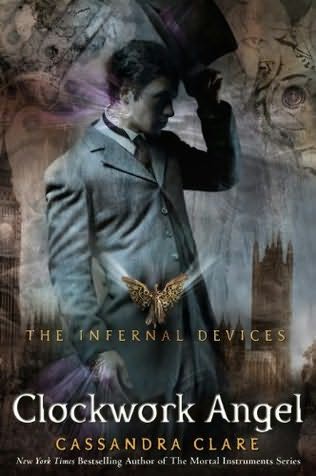
Clockwork Angel by Cassandra Clare + Contest!

Pub date August 31st, 2010.

When sixteen-year-old Tessa Gray crosses the ocean to find her brother in Victorian England, something terrifying is waiting for her in London's Downworld. Kidnapped by the mysterious Dark Sisters, who are members of a secret organization called the Pandemonium Club, Tessa soon learns that she has the power to transform at will into another person. The Magister, the shadowy figure who runs the Club, will stop at nothing to claim Tessa's power for his own. Friendless and hunted, Tessa takes refuge with the Shadowhunters, warriors dedicated to ridding the world of demons. She soon finds herself fascinated by - and torn between - two best friends: James, whose fragile beauty hides a deadly secret, and Will, whose volatile moods keep everyone at arm's length. As their search draws them deep into a plot that threatens to destroy the Shadowhunters, Tessa realizes that she may need to choose between saving her brother and helping her new friends save the world . . . and that love may be the most dangerous magic of all. (book back blurb)

Potential Spoiler Alert!!!
Really, I'm going to try not to give anything away of the plot but what one sees as mundane information another may see as spoiling. This also isn't going to be a glowing review. You've been warned.

When I read City of Bones, I didn't have much issue with the story itself as I did with the writing. The text was drowning in descriptions and the plot was very derivative. I didn't read on in the series because while I was entertained by the story, I wasn't entertained enough to try and slog through Clare's writing again. I have been told that her writing does get better as the series went on but I still didn't venture.

Until Clockwork Angel. I figured by now the writing's improved enough that it isn't going to be as hard for me to get through as CoB was and if it was anything like that book, at the very least I'd be entertained.

Well, thankfully the descriptions of doom did die down substantially. The similes were kept to a minimum and they didn't slap me in the face every time I came upon one (multiple times a sentence). Having said that, the overbearing descriptions were replaced by something more awkward. Every time I did hit a simile (which, as I said, was minimal), I felt that Clare tried to find something to compare whatever it was she was comparing to to but couldn't find the words so she just settled. It's hard to explain. The similes were lackluster and, to me, read rather defeatist. Tired. I found a lot of redundant descriptions that even with a little effort could have been avoided. It was rather disheartening.

As for the overall story, it was slow. Very slow. A lot of exposition. A lot of information is learned from the characters listening in on meetings or having sit-downs or going for walks or whathaveyou. There was much by the way of talking heads and little by the way of action. Tessa was kind of getting shoved around from plot point to plot point without much will of her own. Not to say she wasn't a strong character, but instead of her moving the plot, the plot moved her. Slowly. While I found CA a faster read than CoB, I wasn't nearly as entertained and at times was rather bored with all of the eavesdropping. I get there was a lot of information to be had in this book but there are better ways to relay it.

The whole love theme talked about in the blurb is a shadow to the overall story. It's so slight that, personally, I don't think it bears mentioning in the blurb itself. As for the tearing love triangle, I didn't feel much of that either. I didn't think Tessa's "attraction" to Jem was anywhere near what I think it was to Will. By the blurb you'd think she were equally pulled to both boys. I didn't get that. But I'm sure I can see which boy she chooses by the end of the series. What girl wouldn't want to attempt to reform the asshole prick that treats her like shit? Such attractive qualities, I know. Really, there is nothing appealing about Will. He's an asshole. Yeah, he's had some bad stuff happen to him in the past (which we don't know about even as the story closes) but it doesn't make it okay for him to be a jerk to everyone. But oh, that's just Will. Blech.

The plot as a whole feels really familiar, like I've read something like it before. Really I felt the only thing that was original was the Shadowhunter deal but the more I read about their runes and all the "help" those things provide, I couldn't help but roll my eyes. A rune for opening doors. For protection. For healing. For everything you could possible need. It just seemed contrived. As for the plot: evil megalomaniac has bid for world domination, uses evil robot us-es to attempt to get it (ten points if you get that reference), wants to make confused yet super-powerful girl his wife to parasite her power, girl gets saved by superheroes, whom she teams up with to save the day. It's just . . . blah.

As for the actual clockwork angel . . . don't think you're going to find out what that is. Just don't even think about it when you start reading the book and don't try to keep guessing as the story goes along. If there is an answer, it's not in this book.

I liked a lot of the history and my favorite part was where Tessa was with the Dark Sisters. Unfortunately that was the very beginning of the book. The tension just seemed more real. I liked the mystery and the intrigue but once she's out of there, I found my mind wandering.

Overall, I was actually much more disappointed with Clockwork Angel than I was with City of Bones. The writing's nominally better albeit heinously overwritten and the story's short on action and on giant in talking heads. I see the book as being entirely exposition for what's coming in the series. Tessa gets to London. Shenanigans ensue. She now realizes what she must do. I could have lived without it but I hope it ends up in the hands of someone that'll appreciate it more than I did.


Contest Time!!!

With stipulations! I want to make sure this book gets into the hands of someone that'll read it and then spread the word about it. I don't normally limit contests like this but considering the popularity of Clockwork Angel, I don't want the copy getting sucked into oblivion, never to be seen again.

ONLY A BOOK BLOGGER CAN WIN THIS BOOK!!! Not a cake blog, a bible camp blog or a cross stitch blog. A BOOK BLOG. Yup. You heard that right. You must have a book blog to enter, at least 3 months old with an average posting rate of 2 to 3 entries per week. You will also acknowledge that you agree to review the book once you're done reading it. No time frame but the word should be spread about it. If you do not meet this criteria, do not enter. I will be verifying all entries and those that don't fit will be deleted. Other than that, fill out the form below and good luck!


Tuesday, August 11, 2009

Viola in Reel Life by Adriana Trigiani + Contest!

Pub date - September 1, 2009.

Three reasons why Viola Chesterton knows she'll never survive her first year at boarding school.
  • She has to leave behind her best friend, Andrew.
  • . . . and replace him with three new roommates who, disturbingly, actually seem to like it there.
  • "There" is South Bend, Indiana, which feels about as far away from her hometown of Brooklyn, New York, as you can get. (book back blurb)
This book gets ten points alone for not being Tall Tales of the Moron Girls and How to Talk Like a Douche. There was literally a sigh of relief as I started reading this because it wasn't stuffed sausage-tight with so-hip-you-need-a-new-one slang and absolutely ridiculous situations.

But . . .

I started getting antsy, anxious, for something to happen. It was so boring and . . . ordinary. I can understand the realistic aspect to it and trying to make that kind of connection to readers that this could very well be a real girl anywhere having to adjust in a situation like this. But just think about it. How exciting is your normal, everyday girl going to school? Exactly. That's what Viola is.

The book is about the year in Viola's life where she goes to boarding school and has to adjust and learn a few life lessons. The thing is, it's so realistic it makes for a really dull read.

There's no drama. Well, next to none. And I felt that by the end of the book I should be holding hands with someone and singing Kumbaya or something. It was just so Brady Bunch uneventful. Hell, I think the Brady Bunch were more exciting. I mean, for a girl that's pretty much a loner and isn't the nicest of people to her roommates the first day of school, they sure seem to forgive her really quickly and they all become the bestest of friends. There's no head-butting with other girls, no rivalry, no normal social situations that real normal girls go through in school. It's like these characters existed in a love-in vacuum.

There's a hint of intrigue in the story but it pretty much stays that way. A hint. It leads Viola down this road to making her movie but it's just like seeing something in the right time and place. The only excitement going on around you when something like that happens is the epiphany going off inside your head. The only one that cared was Viola. And her Partridge Family friends.

The situation with Andrew was . . . meh. It worked itself out in the end. He joined in the Kumbaya sing-along. Jared on the other hand . . . well, it was another lesson Viola learned. Next time can we make these lessons something resembling compelling, please? Being steeped in ordinary is so BORING. I mean, they were good lessons and all but it was trying so hard to be realistic it ended up not being realistic. Does that make sense? No one goes through their freshman year in high school that easily, even with the "issues" Viola had. NO ONE.

That's not to say a book needs fantastical elements or ridiculous mememe drama for it to be compelling. But the lives of ordinary people are boring and shouldn't be written about. They need spice. This book would have been better with a modicum of tension and drama that actually exists in real school situations but it was so strawberries and cream glossed over that it eradicated it. It's like The Babysitters' Club on Prozac or something. Full House had more tension than this book.

The writing itself was a little awkward too. I know this is an ARC but a couple of things stood out that my gut tells me aren't things that are going to be fashioned out on the last copy edit. Namely dialogue and infodumping.

I have a feeling that dialogue isn't this author's strong point. They were all very stilted conversations and none of the characters really had their own voices. When one said a line, it could have been interchanged with any other character and it wouldn't have made a difference. I mean, not all teens talk like tools but most do use contractions.

And I really shouldn't say infodumping because that implies massive chunks of exposition which there aren't. What I'm talking about are things like conversations, or emails, between two characters where they would say things that are very obviously for the sake of the reader and not for each other. It comes off very unnatural. For instance, Cailtin, one of Violet's best friends from Brooklyn, sends Violet an email. In it she mentions her aunt. Seeing how often Caitlin talks about this woman, and how long they've been friends, Violet should already know who she is. But she goes into small detail about her aunt, "you know, first name, last name, what she does, why she's being mentioned." It's very awkward and very obvious that that information isn't there for Violet's benefit. She'd already know it.

And it really annoyed me when Violet kept saying South Bend, Indiana, South Bend, Indiana, South Bend, Indiana. The full city and state. Constantly. No just South Bend. And no just Brooklyn either. Rarely. Brooklyn, New York. Brooklyn, New York, Brooklyn, New York. When you say Brooklyn, who the hell won't know what you're talking about? And what irked me even more, and this is something so minute but it goes against the grain of the character, Violet rarely called Brooklyn home. For how much she missed it, it was always Brooklyn, never home. That bothered me. A lot.

So I went from one extreme, Alphas, to another. It's not a bad book. It's just uneventful, which can equate to boring. Just think about how much you'd want to read the diary of your normal, everyday girl. Then again, I'm pretty sure your normal, everyday girl goes through normal everyday high school shenanigans which seem to be left out of Prefect Academy in South Bend, Indiana. Check your normal high school/boarding school at the door and welcome to Stepford.

Personally, when I read a book, I want something that's going to excite me, in one way or another. Not a boring girl's journal.

And what the deuce is with the boarding school craze? I don't get it. I live within ten minutes of two prestigious girls' boarding schools and every time I passed them when I was younger, I cringed. Now they're supposed to be appealing and real world "fantasy"? Stumped me.


CONTEST TIME!!!

You want to give it a try? Enter to win my ARC!

Leave a comment with your email answering this question--

What was the biggest adjustment you had to make in school?

No answer, no entry. Period.

+ 2 for following
+ 2 for linking (no extras here)

Open to US residents only, this one will end September 1st. Good luck!

Monday, June 1, 2009

ghostgirl by Tonya Hurley

First published in 2008.

Sometimes high school really is a matter of life or death.

Now I lay me down to sleep.
I pray the Lord my so
ul to keep.
And if I should die
before I wake,
I pray the popular to attend my wake.

Charlotte Usher feels practically invisible at school and then one day she really is. Even worse: she's dead. And all because of a guy and a gummy bear.
(book back blurb)

Seriously, who could resist this pretty cover? It's all 3D and stands out from the regular paperbacks and hard bound books. Not to mention the page quality on the inside goes above and beyond most anything else in books on the shelves. It was so hard to resist but I caved eventually. Being human and all , nothing is 100%. While my Canadian friend and I have a near-identical taste in books, it's not exact. She liked this book and recommended to it me. Another motivating factor to pick it up. I, on the other hand, was very, very torn.

I wanted to like it. I wanted to like it more than I actually did. At the end, I was split two ways on it - one as a writer and the other as a reader.

As a writer, I just can't help but wonder why the editors let this slide. The headhopping at times got just downright confusing. Not only did it hop at breaks, which was much easier to handle, but it hopped from paragraph to paragraph. Walking the line between having a good third person omniscient and headhopping is very, very fine, not to mention subjective. What is a graceful segue from one character head to another over the course of a page is jarring head hopscotch to another. To me, these transitions were just not smooth.

And don't get me started on the dialogue tags. There were -ly words in that book that I didn't even know existed and that I'm pretty sure haven't made their way into Webster's yet. A couple had me going WTF? so that was something else to pull me out of the story.

The reader/writer blends from here on out because you don't have to be a writer to pick up on these next few things.

I thought Charlotte was an amazingly static character. A ghost with tunnel vision that wanted nothing more than to manipulate and use everyone and everything just so she could get the guy. Aside from the thoroughly superficial aspect of it all, and while it takes teenage obsession to what could be a very funny extreme, I don't think it worked here. In all honesty, I think the book was told, for the most part, from the POV of the wrong MC. I think it should have been Scarlet's story. She's a much more dynamic character, much more interesting and changes because of Charlotte to be a more open-minded person. Charlotte, on the other hand, changes not a bit.

Until the end, apparently, where the change is so sudden and out of the blue that you're left going, "did I just get poked in the eye?" I understand the point being made and the difference between the chase and obtaining but considering that whole moment lacked internal thought of any kind that could potentially explain the shift, it had me going WTF? All of a sudden Charlotte and Prue are buddy/buddy and she no longer wants Damen. Huh? No segue, so shift, just bam! 180. Story ends.

Charlotte just really pissed me off as a character. I was ready to call Ghostbusters on her ass and have her incarcerated in one of their traps just so she'd cut out the incessant want to get with Damen. I cared so much more about all of the other characters and her big "lesson learned" at the end seemed written as an afterthought. As if the author forgot the book had to end, wrote that in quickly and everything's all sewn together nice and neat. I just found it unbelieveable. There was no change in the character up until that very moment at the end where everything gets resolved. No change. None. No second thoughts, no second guesses, no "maybe I shouldn't do this." It was all just Damen, Damen, Damen. "How can I get Damen?" And then, as if her meds wore off, "Nah, I don't want him anymore." WTF?

For all the pretty packaging, I don't think what's on the pages is all that stellar. I think there could be a really good story in there but like I said, I think the focus was on the wrong character. It could have been so much better if Scarlet were center stage. On an upside, though, I think it would make a cute Tim Burton movie. Definitely. Saw that the entire way through. And at least the dark humor and jokes wouldn't fall flat in a Burton flick.

This is one of those library books. Really, it could go either way. I've without a doubt read worse but I've absolutely read better. Check it out from your local or borrow it from a friend before getting sucked in by the wrapping and splurging on your own copy. It might not be everything you thought it looked like it could be.


Thursday, March 19, 2009

The Seventh Tower - Castle by Garth Nix

First published in 2000.

I’m having issues finding a synopsis for just this book instead of the entire series and the book I have is a three-in-one so that’s not all that helpful either. So I’ll try and sum this one up for you.

Tal has bound himself to Milla, and vise versa, in order to get himself back to the castle. In exchange for his safe return, he must get Milla a Sunstone in order for her to take it back to the Icecarls. Getting back into the castle, since Tal hasn’t heard of anyone actually doing it, proves much more difficult than climbing up a mountain. He’s pushed to the physical and mental limits that even he didn’t know he had, not to mention he starts to question his own standing in life. When Tal and Milla are captured by henchmen of Sushin, Tal’s mortal enemy for unknown reasons, he has to figure a way out of the mess he’s in and help Milla because it is his fault, after all, that she ended up trapped in his world and incarcerated in the Hall of Nightmares.

I have to say, this one is much better than the first, not only in writing style but in exposition as well. I think it had a lot to do with it shifting back and forth between Tal being someplace foreign and Milla being someplace foreign so there’s a lot more explanation going on which helps to develop the story in my head a little better. That’s not to say it doesn’t have its moments of ‘what is that?’ because it just gives you a name without a basis for comparison, but it’s quelled a lot.

By the end Tal gets over his “Milla’s barely a step above Underfolk” superiority that he carried for a large enough chunk of this book that it was still annoying. The girl saved his ass time and time again yet he saw her as beneath him, in some fashion or another. Product of his upbringing, I know, but usually, when someone stops death from taking your life, you’re grateful, not expectant that that’s how it should be regardless. Granted Milla isn’t exactly a daisy to be around but at least she doesn’t have the caste mind that Tal has.

I was getting pretty annoyed with all of the conveniences that seemed to surround Tal to help him out of otherwise futile situations. The more I see and understand these Spiritshadows and shadowguards, the more I see them as deus ex machina pieces that serve to make the journey easier for the MC, to help him out of situations he’d otherwise get stuck in. A security blankie. The things just proved too useful.

As did Uncle Ebbitt. Aside from the fact that his “wacky” demeanor felt contrived, at best, he always seemed to appear at the most opportune moments to help Tal along. When he was in the Pit, that was supposed to be an illegal holding cell. You’d think it’d be under better guard and an Underfolk with a hacksaw in a cake wouldn’t be able to get by and give it to Tal. Or how Ebbitt comes in to save the day just at the moment Tal’s able to get out of the Pit.

I did like Milla’s ability to thwart Fashnek and his crystal globe of nightmares. That, to me, made sense because she’s not of that world. She holds powers that they don’t know of so to see her exhibit something that was otherwise unfamiliar was almost expected. The execution of relaying why she had that power seemed a little forced, but the power itself was pretty cool.

With Tal leveling out and doing things for the greater good instead to protect his image, not to mention the stilts of the story getting shorter, the books are getting more tolerable. It’s decent but I’m still leaning towards this kind of high type of fantasy to not really be my thing. It’s a little much, especially when the emphasis is on the world instead of the characters, the situation or the plot.

Related Posts Plugin for WordPress, Blogger...
 
Blog designed by TwispiredBlogdesign using MK Design's TeaTime kit.