






Showing posts with label contemporary. Show all posts

Tuesday, October 9, 2012

Four Secrets by Margaret Willey + Giveaway!

Published October 1, 2012.

Author website.

"To you the idea to kidnap Chase Dobson might seem like a mistake. But to us... we were just trying to stop him from being so...evil. We just...we had to stop him. No one helps kids like us. Not at my school. We aren't the important kids. We knew it wouldn't stop unless we stopped it ourselves." 

Katie, Nate, and Renata had no farther to fall down the social ladder. But when they hit bottom, they found each other. Together, they wanted to change things. To stop the torment. 

So they made a plan. One person seemed to have everyone's secrets—and all the power. If they could stop him... 

But secrets are complicated, powerful things. They are hard to keep. And even a noble plan to stop a bully can go horribly wrong.  (netgalley.com)

The most prominent issue I had with FOUR SECRETS was the age of the three protagonists and the talked-about antagonist.  They're all supposed to be in eighth grade but I kept finding that I had to remind myself that these weren't kids in high school.  Just the extent of the issues they were having, how they spoke about it, how they carried it out it, just seemed so far beyond someone still in middle school.

Granted have it set their freshman year in high school and I probably wouldn't have batted an eye.  Not much of a difference age-wise in the slightest but the association is different.  In my mind there's a pretty big gap between middle school and high school and the voices I kept reading, at least to me, were high school age.  I just wasn't convinced they were middle school, especially when body sizes came into play.  All except Renata were described as large, either in stature or bulk (and by bulk I mean muscle).  It just didn't fit for me and it was a point of contention throughout and every time I was reminded of their ages it wrenched me out of the story a little bit.

But other than that it was a really good, pretty fast, read told from the perspectives of four different people, Chase excluded.  I could wholly empathize with the feelings of the social worker whose job it was to get to the bottom of why these kids kidnapped their classmate.  Because they entered into some kind of pact they wouldn't talk and she ended up getting the creative runaround from all three of them.

Nate told his view in story form, referring to the people involved by assigned fantastical names and set in a scene that only vaguely alludes to what actually happened.  Yeah you can get what he's saying but his was the portion of the book I liked the least.  I was over his method of storytelling pretty quickly and while I'm sure it helped him to cope with the situation he was seeking solace in a fantasy world instead of coming to terms with what happened.  He frustrated me the most.

Renata you see very little of within her own viewpoint, told, or rather shown, through her drawings.  Otherwise you get a picture of who Renata is by the way Nate and Katie describe and talk about her.  That would have been annoying to me if it weren't such a perfect way to get across Renata's personality.  She is very much a background girl that doesn't speak very often but when she does, whether it's actually with her vocal chords or with her drawings, it's so poignant you can't help but listen.  She's described as incredibly small and for most of the book that's the image I had in my mind: someone who was frail, tiny and needed rescuing when in fact she was exactly the opposite.  Next to the social worker I think I liked Renata the most.

Katie is the most prominent voice in the story aside from the social worker and its through her you learn the most information in a manner that won't have you trying to put puzzle pieces together.  Her method is very straight forward and when she started the second "rouse" journal I grunted in agitation.  I WANTED her to reveal what happened because I knew it wasn't what the situation looked like.  I think that was pretty evident from the beginning.  But there wouldn't be a story if that happened so I bided my time reading Katie's story broken up by lunches and homework and recreation time.  She was the most readable in terms of figuring everything out.

All three were hard-set in their ways when it came to not breaking this pact.  For the life of me I couldn't figure out why and while it worked out in the end I don't feel there was proper punishment doled out for the responsible parties.  The story resolved itself nicely enough but it was a little on the abrupt side and lacking in satisfaction.  I wanted more.  Comeuppance, maybe.  A knock off one's high horse, if you will.  The story resolved itself within one book which is a plus all around but there's a little bit more there, even if it's just ten or twenty pages.

While not my favorite Carolrhoda Lab book that's not to say it wasn't a good read.  FOUR SECRETS has points of view for every type of reader of a multitude of ages telling a story about bullying and how NOT to go about remedying it.  I don't want to give away the ending but through the eyes of the social worker you can see just how hard the gears are grinding, what's up against these kids and just how thin of a wire they're all walking on.  Bullying sucks, sure, but there are ways to go about fixing it that won't land someone in jail.  There's an air of noble cause and valiance in the book as well that may sway towards, in my eyes, the wrong way of fixing things but there is a balance there and Willey does a good job of playing both sides of the game.  It also goes to show that everyone has secrets, even the most perfect of people, and sometimes they're far darker than bad hair days.


Ban Factor: High - Kids taking matters into their own hands and being OKAY with going to juvenile detention?  Le gasp!

Giveaway Time!!!

Want to win my ARC?  Then just fill out the form below for your chance.
  • Open to US residents 13 years of age and older only.
  • One entry per person per email address.
  • Duplicate entries will be deleted.
  • Entrants must be a follower of Bites via one of the following mediums: GFC, RSS, Goodreads, Facebook, Twitter, Tumblr.
  • Giveaway ends October 23rd at midnight AZT (3 am EST).

Saturday, August 25, 2012

In Too Deep by Amanda Grace

Published February 8th, 2012.

Author website.

Carter didn't rape me. People at school think he did. Suddenly, new friends are rushing to my side, telling me that Carter hurt them, too. They say he's getting what he deserves. 

Maybe I don't want to fix this. 

Sam is in love with her best friend Nick, but she can't seem to tell him. So she decides to flirt with golden-boy Carter Wellesley, hoping Nick will see it and finally realize his true feelings for her.

On Monday, everyone at school is saying that Carter raped Sam. He didn't, but Sam can't find the words to tell the truth. Worst of all, she's afraid she'll lose Nick if he finds out what really happened. 

As graduation approaches, Sam discovers that living the lie isn't as easy as her new friends make it sound--and telling the truth might be even worse.  (goodreads.com)

I thought I was going to get pretty enraged by IN TOO DEEP because I have some pretty strong feelings about girls crying rape but it wasn't too bad.  I think ultimately it was all handled really well, the protagonist went through a sufficient level of guilt and it wrapped itself up realistically so I really don't have any complaints.

IN TOO DEEP tackled all the relevant avenues that it could potentially go down, I think, from claimant guilt to what's happening to the guy to his future to her future to the repercussions to outward reactions in the face of the lie's reality and a bunch of things in between.  But it doesn't touch on how a lie about rape ultimately undermines a claim of rape.  In fairness it wasn't relevant to the plot but at the same time I do wish it was touched upon.  It's hard enough for women that were raped to come forward.  When a woman cries rape for her own gain it undermines the claim for all, making people that little bit less trustworthy of the next woman to claim she was raped because the last person they knew lied about it.  There is just no winning for anyone when rape is claimed when it didn't really happen and while IN TOO DEEP does touch upon most of it I do think it would have been just that little bit stronger if it broached undermining as well.

Irrespective of the lie it is pretty awful what Sam goes through when people believe it, especially at the hands of Carter's friends who believe his story blindly.  If it were true they'd still be doing the same thing and while it was rough to read something like that I think it's unfortunately accurate.  Rape is belittled constantly when it has actually happened so it's no surprise that Sam suffered the things she did at the hands of the buddies of her supposed rapist.

It's hard to say that Sam is a likable character because she cried rape and then perpetuated the lie due to peer pressure and a need for vengeance but I didn't dislike her.  I didn't find her reprehensible or a disgusting human being.  She's a girl that was scorned by an incredible douche bag.  That doesn't make what she did right but I think it explained enough to make me believe it, especially when the other girls bring in their own stories.  Yes, Carter was a douche and yes even I, reading this, felt just a little bit of joy seeing the high and mighty knocked from his pedestal.  But rape is a devastating tag and not even the biggest of douche bags deserve to have that kind of lie haunting them for the rest of their lives.  It only succeeds in ultimately turning the douche into a victim and garnering him sympathy.  Kind of the adverse effect.

I found the end wholly satisfying because everything worked out how I felt it should for everything that had happened.  For a while there I was a little afraid that it would tank, that I'd end up with another ACCOMPLICE that had me raging.  It didn't.  All of the repercussions you'd expect to happen do and it feels right.  Lessons are learned at great cost and life goes on for all.  Sickly sweet need not apply.  The end is rather ugly but it's deserved and what's even better Sam knows it and accepts it.

IN TOO DEEP delves into an aspect of a dark event that I don't think too many people do.  Everyone's always so focused on the real act of rape that they don't consider what an unsubstantiated accusation can do to someone.  I like it for it's difference in that regard.  That's not to impugn rape but look at it from another angle where things aren't what they seem.  The Duke lacrosse scandal is probably the most prominent example of something similar to IN TOO DEEP.  It's a good read and immensely satisfying, as odd as it sounds.  I'm a fan of characters suffering realistic repercussions for their actions.


Ban Factor: Medium - Reading would need to be involved in this one to find the references to high school sex and drinking.  On the surface it might not set off too many alarms although they may be intrigued to see how a liar suffers.

Thursday, August 2, 2012

The Humming Room by Ellen Potter

Published February 28, 2012.

Author website.

Hiding is Roo Fanshaw's special skill. Living in a frighteningly unstable family, she often needs to disappear at a moment's notice. When her parents are murdered, it's her special hiding place under the trailer that saves her life. 


As it turns out, Roo, much to her surprise, has a wealthy if eccentric uncle, who has agreed to take her into his home on Cough Rock Island. Once a tuberculosis sanitarium for children of the rich, the strange house is teeming with ghost stories and secrets. Roo doesn't believe in ghosts or fairy stories, but what are those eerie noises she keeps hearing? And who is that strange wild boy who lives on the river? People are lying to her, and Roo becomes determined to find the truth. 


Despite the best efforts of her uncle's assistants, Roo discovers the house's hidden room--a garden with a tragic secret.  (goodreads.com)

To start off with fairness this is an MG read, not my forte but if the story sounds intriguing enough I'll snag it.  THE HUMMING ROOM fit this profile.  I keep a special place in my cockle area for things related to THE SECRET GARDEN so when I saw that this book was influenced by it I accepted it for review.  It was definitely a riveting story but the ending was abrupt, a blink and you miss it kind of thing that derailed the rest of the work for me perhaps a little more than what it should have.

Roo is an unfortunate case born to the wrong parents and as a result ends up in the care of her uncle who's more absent than present and keeps his kid locked up in his room for his sake, apparently.  It's a cyclical thing.  Phillip got depressed when his mother died and became bedridden but his father didn't really know what to do with himself and became more withdrawn, making them both more reclusive and fostering an environment of neglect and anti-social behavior.  Crappy situation.

Roo's a spunky little thing and doesn't put up with the crap that's been allowed to foster in this house and, as can probably be predicted, her presence riles things up, disrupts the otherwise fragile order of things.  THE HUMMING ROOM sticks pretty closely to THE SECRET GARDEN storyline so if you know the latter you'll know the steps Phillip takes and ends up with a reintroduction to his father and all of that.

Really it's a compelling story with the scene set magnificently.  The house, which is really an old children's hospital, is given this incredibly creepy air that'll give you the chills just reading it.  I mean how horrifying would it be to live in an old hospital where more children died than lived?  Seriously?  It may be Stephen King's wet dream but I sincerely doubt it's a child's first choice at a play place.  But I think that was the best part of THE HUMMING ROOM, Potter's ability to make Roo's surrounding shine.  Or cake them in cobwebs, as it were.  The setting itself was it's own character, from the personification of the river to the garden, everything was alive.

I felt Jack, the river boy, was ultimately irrelevant to the plot as a whole since the story really centered around Roo, Phillip and Roo's uncle.  He was a means to draw Roo out of her shell which precipitated the events that moved the story forward but he didn't have much else of a function.  Remove Jack from the story and I think it would have worked out just fine.

As for the end, like I said above, it was really abrupt and I felt it was resolved too easily, glossing over what could have been a really good healing period to see between Phillip and his father for a flash forward moment.  It plays into the nice resolution that I think a lot of MG novels have but as an outsider looking in it left me a bit unsatisfied.  I would have liked to have seen more.

Ultimately it's a read with a lot of ambiance that follows pretty closely to THE SECRET GARDEN premise.  It's a good story and you'll end up feeling a lot for Roo, I think, since she really is an unfortunate character and the adults are a little less than understanding towards her (you can start a drinking game for how many times they threaten to send her back to foster care as a means of discipline, effing terrible).  But she's a BIG character that, once she's out of her own shell, will pull others out of theirs as well.  She's goal-oriented and has an uncanny knack for hearing the earth thrive.  Kind of weird but it has it's part in the story.  A good story at that.


Ban Factor: Medium - The banners would actually have to read it but there's a lot of bucking adult instruction going on.  We wouldn't want to give children any ideas that they shouldn't always listen to adults, now would we?

Thursday, July 26, 2012

Vanishing and Other Stories by Deborah Willis

Published August 17, 2010.

Author website.

In Vanishing and Other Stories, secrets are both kept and unearthed, and lives are shaped by missing lovers, parents, and children.  With wisdom and dexterity, moments of dark humor, and a remarkable economy of words, Deborah Willis captures an incredible array of characters that linger in the imagination and prove that nothing is ever truly forgotten.  (book back blurb)

Every once in a while I'll come across a book with such stunning writing that when I get to the end of it I can't help but heave a great big sigh of relief.  There is hope.  There is talent.  There are WORDS.

I like reading anthologies but they're usually a compendium of stories from different writers so each work is, by default, going to be different.  Different styles, different prose, different methods.  Personally I find it a lot harder for an author to write a single anthology composed entirely of their own stories and have each story differentiate itself from the last.  My experience in that is pretty even keel; one working out not so well and the other I ended up loving.  VANISHING?  Yeah, I pretty much loved it.

VANISHING has stories told of life.  They're not all that action-packed.  In many not much really happens outside of a character's internal monologues.  But the way they're all written Willis just sinks her claws into each and every one of her characters and forces them off the page so that you can't help but see them as their own individuals.  And that's exactly what they are.  From the grieving scientist in ESCAPE to the lonely teacher in THE FIANCEE to the boy-turned-man in AND THE LIVING IS EASY, each are individuals, each are wholly separate and each are as vivid in my mind as if they were all given their own books.

VANISHING is one of those books that one SHOULD read because it's that kind of book.  These are the stories that would get taught in literature classes, dissected for meaning, subtext, intent.  To some that's a bad thing but I loved reading good short stories when I was in school.  It was how I was introduced to the likes of Flannery O'Connor.  And she's pretty awesome.  But just because people SHOULD read it doesn't make it bad or dull.  They're all engaging stories, each and every one of them, with a range of protagonists, a range of ages and a good mix of both sexes.  There is literally something for everyone in VANISHING and the writing is so good all the rest would just suck you in anyway.

All of the stories are inherently real, spun golden by words that would make any writer envious (including this one).  But it's not a high falutin, overtly showy type of writing.  It's glorious, simple enough to hook the resistant but intricate enough to ensnare the more well-read, those with noses held higher than others.  When literary does it right, it REALLY does it right.  Willis's writing is effortless.  She doesn't come across as trying to impress or show off her writing prowess.  Her words are for the stories and the stories are for you.  It's that simple.  And they're wonderful.

There may not be anything supernatural in VANISHING but that doesn't make it any less engaging.  It still hooks, it still drags you in and then spits you out, leaving you reeling in your book hangover because the writing . . . THE WRITING.  It stuns.  It really does.


Ban Factor: Low - It's pretty innocuous.  There might be a couple of salacious pieces in there but that would require the banners to read and that's just downright silly to expect.

Thursday, July 12, 2012

Faking Faith by Josie Bloss

November 8, 2011.

Author website.

Dylan Mahoney is living one big unholy lie.


Thanks to a humiliating and painfully public sexting incident, Dylan has become the social pariah at her suburban Chicago high school. She's ignored by everyone--when she's not being taunted--and estranged from her two best friends. So when Dylan discovers the blogs of homeschooled fundamentalist Christian girls, she's immediately drawn into their fascinating world of hope chests, chaperoned courtships, and wifely submission.


Blogging as Faith, her devout and wholesome alter ego, Dylan befriends Abigail, the online group's queen bee. After staying with Abigail and her family for a few days, Dylan begins to grow closer to Abigail (and her intriguingly complicated older brother). Soon, Dylan is forced to choose: keep living a lie . . . or come clean and face the consequences.  (goodreads.com)

ALBATROSS set the bar pretty high when it came to Josie Bloss books so when I had the opportunity to review FAKING FAITH I jumped at it.  While it definitely didn't disappoint it didn't have the same impact for me as ALBATROSS did.  The latter had excellent timing (I'd just read TWILIGHT and it's anti really spoke to me) plus I connected with it on a deeply personal level.  FAKING FAITH was good; it was eye-opening but it took a pretty big suspension of disbelief to really get into the plot.  A teen faking her way into a fundamentalist Christian home?  I'm pretty sure they would have been able to sniff her out almost immediately.

Dylan screwed up royally, against the advice of her friends and her little inner Jiminy Cricket screaming at her that her uber-hot douche boyfriend was all wrong.  She ends up being a social pariah in a way I thought was a bit forced: in a drunken stupor she blows off her friends for this boy.  Instead of recognizing the act as just that, a drunken idiocy, her friends take it to heart and things escalate from there.  Blowing off happens, shunning occurs and then Dylan's relationship blows up in her face and she's all alone.

For some insane reason she retreats to the world of fundamentalist Christian girl bloggers and their seemingly far simpler way of living.  I can half understand something like that.  They live such an isolated life, free of cell phones and high school and all the other machinations of the modern age.  What Dylan doesn't really comprehend until she takes on the persona of Faith and visits her online friend's farm is that that kind of living comes at a price and she effectively shatters pieces of a family with her ignorance of their world and her insistence of hers.

It's very Lifetime movie-esque and your standard friend make-ups happen at the end.  Dylan realizes her life isn't terrible and sometimes simpler isn't better.  But what kind of bothered me, and I'm going to play devil's advocate here, is how the fundamentalist life is portrayed as ultimately wrong.  Yes, Abigail's father was a controlling dick that reveled in being the master of his domain.  Beau, Abigail's intended, is a creeper that needs to have his junk cut off and the women are 100% subservient to the men, subject to doing only womanly duties and being married to someone her father chooses only.  Yeah, those things suck.  But this is a belief system.  In this world we live in now we view it as wrong.  Women are strong, independent beings that can make our own choices in life.  I mean the Crusades were fought because one set of people felt another set believed the wrong thing.  Bam!  War.  What happens if this kind of structure is what's holding these people together?  What if releasing them into the greater world is what unravels them?  Is their belief system still wrong?  Yes, Abigail was clearly not looking forward to her life with Beau but she stood by her convictions.  This was what was right FOR HER.  Dylan didn't understand that.  Hell, I don't understand it.  But it's HER choice.  She is actively making it even with Dylan sitting there offering her help on a silver platter.

The book painted really good juxtapositions between Dylan's and Abigail's family.  Yes, the fundamentalist Christians are extremes (arranged marriage?  really?  NOW?) but they are a cohesive family unit.  The children were far better behaved than many "normal" children, they ate meals together, the survived together.  They functioned as a unit.  Dylan's family had every freedom of the modern world but they barely knew each other.  Family time?  Right.  Sure they sat at the same table to eat cereal but there were always laptops and smartphones involved.  Dylan even points these polarities out and it's something she came to really love about Abigail's family despite their faults.  As a result Bloss really begs the question: which is the correct life?  Or is it something in between?

FAKING FAITH is a novel that will definitely make you think.  It paints the extremes as very extreme but neither are without their pros or cons.  You see the happiness of both and you see the pitfalls of both.  There is a slant, of course, but I'd think it'd be hard to write something like this without swaying at least a little.  It's a good contemporary with it's crux centering around the pervasive notion of the internet and how is can ruin people.  How running and hiding from your problems only manifests all new ones.  How the only way to fix things is to confront them head on.

Like I said, very Lifetime but still a good story if you can tuck back the notion that Dylan can lie her way into someone's home like that to begin with.  Another extreme but I don't think it was handled too absurdly.  Her obsession with the online culture was portrayed far better, I think, but the plot needed Dylan to immerse herself in it wholly. And she did.  At least it worked out in the end.


Ban Factor: High - This book basically destroys the ideal life of the religious right, read: banners.  No likey.

I'm adding FAKING FAITH to my Summer Blast Giveaway so if you want a chance to win it be sure to enter!

Monday, July 2, 2012

What We Keep is Not Always What Will Stay by Amanda Cockrell

Published June 8, 2011.

Author website.

Fifteen-year-old Angie never used to think much about God--until things started getting weird. Then Angie falls for Jesse Francis, a disabled war veteran who's a lot deeper than most high school guys. But Jesse is battling major demons. As his rages grows more frequent and unpredictable, Angie finds herself losing control of the situation.  (goodreads.com)

Well, Soldier Boy has completely invalidated this entire book.  Look, it's not 1941 and you have sixteen-year-olds bluffing their way into the military so they can go fight the good fight.  The reality is no one without a high school degree or its equivalent is getting deployed.  It just doesn't happen that way.  So considering the entire basis of this story centers around Jessie going back to high school at nineteen to get his degree AFTER a deployment, it's pretty much screwed.  Now this was either one of two things on the part of the author: laziness a la SMeyer in not doing the research or willful omission to serve the plot.  Neither, in my eyes, are good.  Yes, you can enlist while still in high school.  You can even go to boot camp between your junior and senior year.  But once you graduate . . . let me say that again: ONCE YOU GRADUATE, your ass isn't going anywhere until you get the required training and THEN you get deployed.  See, the military is a regular job.  If it were listed in the classifieds it'd require a high school diploma or equivalent.  They're not going to get anyone without some kind of degree into any kind of potential leadership position.  I'd like to think they wouldn't let them around such heavy artillery either.

On top of that I'm not a fan of how PTSD was portrayed either.  Just a little of my background, I'm the daughter of a Special Forces Vietnam veteran, the girlfriend of a twice deployed Army officer Afghanistan veteran and I have a slew of friends and family that fall into the category of Veterans of Foreign Wars.  And I can assure you I have never once, ever, witnessed someone drop under a table because of a loud noise or flip the fuck out on someone because THEY JUST DON'T UNDERSTAND.  You see, people have a tendency of canonizing soldiers because of what they do.  The thing is, soldiers are culled from regular people.  What's mixed in with regular people?  Douchebags.  Thusly there are also douchebags in the military.  The uniform or what war they fought in doesn't exonerate their douchiness.

So we have Jessie that's the Hollywood textbook example of PTSD (*shakes fist at Hollywood*) (when in reality PTSD is mostly more subtle but things like insomnia just don't drive enough drama) when it comes to flashbacks but he also spouts off random shit at Angie when she gives opinions on more political things.  But he's been through a lot.  He's a bit bi-polar too and towards the end of the book hints are dropped that he may have some kind of head trauma but it's never fully realized.  And he's a bit of a would-be rapist as he tried to rip Angie's pants off of her while she fought him off.  But she can't possibly call the cops because HE'S BEEN THROUGH SO MUCH ALREADY.  *headdesk*

Jessie is a douche.  Dick.  Jerk.  Fuckface.  But every single character in this book excuses his actions because he's a vet and HE'S BEEN THROUGH SO MUCH.  Even Angie as she had to kung pow her way away from a future rape kit in an emergency room excuses his actions because HE'S BEEN THROUGH SO MUCH.  And this line of thinking is never remedied.  The moral of the book is basically vets can get away with anything because THEY'VE BEEN THROUGH SO MUCH.  Want to become a rapist?  Then join the military and people will excuse you for it.  NO.  NO NO NO NO NO.  Jessie is a dickbag.  Period.  I don't give a flying monkey's fart what he's been through.  It doesn't give him the right to be a total dick to people.  It doesn't give him the right to force himself on women.  Oh . . . but . . . he might have had brain damage . . . MIGHT.  Never realized.  Never proven.

And the thing is as the reader you have NO IDEA what Jessie was like pre-war.  No clue.  He could have been a total nut job.  His pre-war life is never discussed in detail except when Angie's mother mentions how nice of a guy he was.  Yeah.  People said the same thing about Ted Bundy.  Next?

So even before Soldier Boy invalidated the entire premise, I wanted to light the book on fire for it's message.  What's even worse, at the end Angie keeps a memento of Jessie to remember him by.  DID YOU FORGET HE TRIED TO RAPE YOU?  But he's been through so much . . . ^%%^(&$(^@@!

Bad message.  Bad, bad, bad.  People can have severe PTSD.  Soldiers have come home and murdered their spoused because they found out they were being cheated on while they were deployed.  That's why adultery is a felony in the military.  It's a trigger for total shit lost.  So yeah, some people can have pretty bad PTSD but thanks to Hollywood, this kind of dickbaggery is looked at as normal.  It's not.  Jessie is just a dick hiding behind PTSD as an excuse to act how he pleases.  That's pretty much it.  And people let him do it.  Because he's been through so much.

Look, I don't care what uniform a person wears.  If they're a dick, they're a dick.  A uniform isn't going to absolve them of that.  A soldier doesn't deserve to be canonized simply because they're a soldier.  Because then you start canonizing douchebags like Jessie and it just gets ugly.  Soldier Boy HATES people like this simply because they're usually faking it to mooch off the government.  In his experience.

As for the rest of the book, I felt like I was reading a twelve-year-old's diary.  It proved for a quick read but the language was scant, leaving nothing to the imagination.  Angie kept wandering off into little tidbits of random information like the Jerry Maguire kid.  I kept expecting her to spout off about the weight of a human head at some point.  Most of her inane ramblings were irrelevant to the plot and more about her day to day life, hence the diary.  It was pretty real in that it was as boring as a teenager's day-to-day life probably normally is but that doesn't really prove for good reading.  A lot of the time she was a whiny brat nagging about getting her mom and step-dad back together or being schizophrenic about Jessie and her feelings for him.  But I will give her credit: when he starts railing on her in public she does stand up to him.  She tells him he's embarrassing her and won't speak to him because of his actions.  But ultimately she gets suckered back in because he NEEDS someone and she's just that person to mend his broken self.  Even after he tries to rape her.

Saint Felix, or the homeless guy that plays him, is somewhat the voice of reason in the whole story, dropping tidbits of advice throughout.  He integrates himself in with Angie's family rather easily and personally I'd be a bit creeped out by it but okay.  There are a few things that don't make sense here so what's one more?  But even when Jessie goes completely bonkers he maintains his placid stoned hippie motif and just spits out veiled comments that merely allude to Jessie's overall troubles, like he's broken.  No shit.

WHAT WE KEEP is an easy read but I found it more infuriating than not.  I hated the message it portrayed and considering none of it could have actually happened my suspension of disbelief is blown.  It's a contemporary.  I'm supposed to be able to believe the major elements of the plot.  If you want to make stuff up write a fantasy.  Otherwise keep it real.  Really.


Ban Factor: Medium - Banners tend towards the far right.  Those people like the military.  So the fact that this book canonized military personnel might be in its favor.  But the insinuation at underage sex, even if it's forceful, might be too pornographic for them.

Thursday, May 31, 2012

Love Drugged by James Klise + Giveaway!

Published September 8, 2010.

Author website.


Fifteen-year-old Jamie Bates has a simple strategy for surviving high school: fit in, keep a low profile, and above all, protect his biggest secret--he's gay. But when a classmate discovers the truth, a terrified Jamie does all he can to change who he is. At first, it's easy. Everyone notices when he starts hanging out with Celia Gamez, the richest and most beautiful girl in school. And when he steals an experimental new drug that's supposed to "cure" his attraction to guys, Jamie thinks he's finally going to have a "normal" life.


But as the drug's side effects worsen and his relationship with Celia heats up, Jamie begins to realize that lying and using could shatter the fragile world of deception that he's created-and hurt the people closest to him.  (goodreads.com)

LOVE DRUGGED was kind of a sad book to read.  Not that it actually made me sad but it was sad to see a boy so uncomfortable with himself that he'd be willing to pop unknown pills and suffer through some horrifying side effects just to be "normal."  But I guess it's true, isn't it?  Even the author admitted in his blurb at the end, that if given the chance when he was Jamie's age he would have taken Dr. Gamez's wonder pills and see if they helped.  The fictional character and the real one can't be the only ones.  In a world where being gay is okay only depending on where you live and who's around you, I can see it being double hard for a teenager, who's just trying to fit in, to want to do everything he can to blend in with the crowd.  It just hurts to read that Jamie took such drastic measures to do it.

Jamie is a compelling character and I was definitely right there, sitting on his shoulder, begging him to not get involved with those pills.  They were ultimately far more hurtful than just having some scary physical effects.  Honestly I'm not surprised the story went where it did.  When you have people that believe that treating homosexuality is akin to getting rid of allergies, it puts their moral stance firmly into perspective.  So when the poo smacked against the rotating device I can't say I was surprised.  I'm kind of shocked that Jamie didn't see it coming but really, he was a bit involved in convincing himself that the pills were working.

What I didn't really understand was why Jamie's parents were the way they were; idea people that got good starts and then fell flat on their faces, ending up being, for the most part, fiscal screw-ups that just couldn't get their shit together.  I wouldn't be so hung up about it if it weren't such a prominent part of the story.  And I'm still unsure as to why.  Them being that way ultimately didn't serve a purpose, it didn't hurt or hinder them as characters.  But Klise was insistent that they were less than stellar financially and they ended up in this position because they couldn't get it together.  Maybe it was a round about way of focusing blame?  If they hadn't moved there Jamie would have never come across those drugs?  Or maybe it was a means of helping him, that final step.  Maybe if they were more stable, Jamie would have felt even greater pressure to be "a man" and wouldn't have found himself.  I don't know.  I'm still trying to sort it out.

I liked LOVE DRUGGED.  It was a strong read that pulled me from one cover to the other.  I was always afraid that Jamie would get found out or he'd get outed outside of his control or the situation would just get away from him entirely.  The plot was always right there in teetering on the edge of everything collapsing.  It did that for most of the story, actually.  And as a result it was only a matter of time before it came crumbling down.  It's a story about a teenager finding himself, and doing some really drastic things to do it.  Sure, it can be just like so many other stories out there.  But it's not.  It's so much more drastic than that.


Ban Factor: High - A book that deals with homosexuality and acceptance.  Whoa!  That's way too damaging for such young eyes!

Giveaway time!!!

Want my copy?  Then just fill out the form below for your chance to win.
  • Open to US residents 13 years of age and older only.
  • One entry per person per email address.
  • Duplicate entries will be deleted.
  • Entrants must be a follower of Bites via one of the following mediums: GFC, RSS, Twitter, Facebook, Goodreads, Tumblr.
  • Giveaway ends June 14th at midnight, EST.


Monday, May 14, 2012

Year of the Beasts by Cecil Castellucci

Pub date: May 22, 2012.

Author website.

Every summer the trucks roll in, bringing the carnival and its infinite possibilities to town. This year Tessa and her younger sister Lulu are un-chaperoned and want to be first in line to experience the rides, the food . . . and the boys. Except this summer, jealousy will invade their relationship for the first time, setting in motion a course of events that can only end in tragedy, putting everyone's love and friendship to the test.   Alternating chapters of prose and comics are interwoven in this extraordinary novel that will break your heart and crack it wide open at the same time.  (netgalley.com)

Now I'm kinda torn on YEAR OF THE BEASTS.  On one hand I liked the voice and the storytelling, along with the set-up of the story itself, how it alternated between prose and comic.  On the other hand I just wasn't all that thrilled with the story and ended up thinking is was a bit melodramatic.

The whole carnival aspect that the blurb emphasized is really minimal.  It happened at the very beginning of the story and while it was the catalyst for the story to move forward the way it did that's the end of its relevance.  Ultimately this story, based on the comic portion, is far more rooted in Greek myth than anything fanciful like a carnival.  Not that there's anything wrong with that but it makes the blurb slightly misleading.

In the prose portion Tessa ends up making herself a rival to her sister, who ends up getting the guy she has a crush on.  And it begins to develop as your standard sibling rivalry except it's a little more one-sided.  Tessa finds herself inferior to Lulu in looks and personality and whatnot.  But Tessa ultimately finds her own boy.  He just turns out to be someone that "isn't acceptable" to the crowd she hangs out with so she hides him.  And he kind of wants to stay hidden, refusing to hang out with her while with her friends.  A bit of a douche.  He redeems his douchiness towards the end of the story but ultimately he's a pretty big dick, saying that he just CAN'T go out with them as a group, blah, blah, emo, blah.

The comic portion runs along side the prose, telling it in a fashion that was so over the top melodramatic that I had a hard time getting over it.  Tessa's Medusa and has to wear a scarf over her hair in order to keep from turning people into stone while Lulu, the beautiful mermaid, gets adored and praised to the point of suffocation.  It was just a little much for me.  Trust me.  I had, and still have, body image issues, but Medusa?  Seriously?  It seemed a little too much for me to swallow.  Great art and everything but it elevated the story to a point just left of ridiculous in my eyes.

The ending had me crying.  Without a doubt it was pretty heart-wrenching.  I did like the way Tessa recovered from it though.  The event at the end changes a lot of people's lives and it opened up their eyes to a greater world.  The ending, really, was spot on.  I couldn't have asked for a better one.  If there was less melodrama leading up to it I probably would have liked it better.

Tessa and Lulu were sort of flowy characters, swirling around each other pretty seamlessly as the story progressed.  They fed off each other, each being strong when the other was weak, providing a homeostasis within the story itself.  But it does get thrown off and people have to adjust.  It's all in how they adjust to that wrench that reinstates that kind of nirvana.  Leading into the ending again it all fit.  Homeostasis was rebalanced, tenuously and for the time being.  But I'll take it.

See what I mean about torn?  I liked it but I kinda didn't like it.  The voice was phenomenal.  I loved how the story was told when it was in prose.  In comic it was a bit much but the art was fantastic.  The plot itself was kind of dull, nothing that hasn't really been done before but the ending blew me away a bit.  Not expected at all.  So can I recommend YEAR OF THE BEASTS?  Probably.  The only way to know if you'll like it is to read it.  I obviously can't tell you one way or another.


Ban Factor: Low - I really don't know what would get banner panties in a twist in this one.  The characters talk about kissing but that's the extent of the sexuality.  Medusa turning people into stone?  Can be horrifying.  Not much by the way of swearing though.  A little bit but you'd need to dig to find it.

Thursday, April 19, 2012

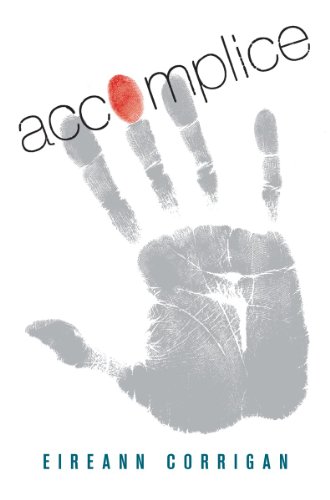
Accomplice by Eireann Corrigan

Published August 1, 2010.


They've gotten good grades - but that's not good enough. They've spent hours on community service - but that's not good enough. Finn and Chloe's advisor says that colleges have enough kids with good grades and perfect attendance, so Chloe decides they'll have to attract attention another way. She and Finn will stage Chloe's disappearance, and then, when CNN is on their doorstep and the nation is riveted, Finn will find and save her. It seems like the perfect plan - until things start to go wrong. Very wrong. (goodreads.com)

Have you ever read a book and while reading it your perception of yourself dissolves into something horrifying? Like you're reading completely awful, irredeemable characters who are unabashedly okay with what their doing that that shame and guilt has nowhere else to go but into you and thus you feel nothing but shame and guilt on these characters behalf because what they're doing is so unbelievably terrible that SOMEONE has to feel bad about it? No? Okay so I felt like a completely awful person for reading ACCOMPLICE, as if it were real and I had the power to stop these two atrocious bitches from carrying on their lie and harming everyone around them but I, too, did nothing and watched it play out in wide-eyed train-wreck horror.

These two girls were sociopaths. Irredeemable, soulless, selfish, atrocious human beings for pulling off a stunt like this. And when it started to head south instead of coming clean and sacrificing themselves because, you know, it was the RIGHT thing to do, they let it all play out at the expense of innocent people, the American public, tax payer money and a good college. Holy crap. Did I mention I felt like a completely worthless human being reading this?

Reading Finn's point of view was disgusting. She kept saying, at points, that she felt bad and this was WRONG and they should turn themselves in but that was interspersed between getting the right camera angle for her face, what outfit to wear on national TV and just what the perfect level of tear face was. Needless to say I had a hard time believing anything Finn said about feeling guilty because her actions spoke far louder than any of her words did.

Chloe was just completely and soullessly insane by the end of it. It's not in her POV but you still get to see her crazy in full on spotlights and you still get to see what a manipulative, egomaniacal bitch she really is and just how much of a lapdog Finn is. I would say blame the parents but I wouldn't know what to blame them for. Not chaining them to the radiator? I have no idea. This was one of those horrible teen decisions that completely raped all other teen decisions by about 30 years in jail. If these were my kids I honestly have no idea how I would react. I certainly wouldn't protect them but I don't know if I'd beat the everloving fuck out of the before they went to jail first or not. And Protective Services would probably let me do it because this is just one of those thing that, well, deserve it.

I only kept reading because I wanted to see how it ended. I wanted to see if these two soulless creatures got their comeuppance. I don't want to spoil so I'll say it was too little, too late. It's only when one gets left in the dust while the other goes off and succeeds and only after the dust bunny sees the aftereffects of the horror they caused does she realize "this is kinda shitty." So like the last sentence redeemed itself but it was like "it took you that long to do it?" Disappointed.

Not to mention I don't find it at all plausible that something like this could actually be pulled off successfully without anyone being any the wiser. There were far too many holes in the girls' logic, too much evidence and too much looking in the other direction to service the plot.

So what do we have? Two heartless bitches decide to pull an epic stunt in order to get into college to the detriment of hundreds of people except them who really don't eat their just desserts in the end although it's insinuated that they do. Finn's actions and thoughts completely contradict each other and Chloe is the obvious benefactor in this equation because she's pretty. Everyone knows you can't be kinda plain and be successful at something like this. As we're so reminded by Finn every other effing page. Yeah, sorry. I don't really have much good going for ACCOMPLICE. The idea was good but the execution was rather horrifying. In a story like this I think it really helps, especially if you have inherently unlikeable characters, to have them get it in the end. And I mean really get it. Because when they don't? It really sucks. There's no validation, no closure, nothing. And that's a killer.

So, um, read it for the crazy chicks. Just be prepared to be the sponge for all the shame and guilt they DON'T feel. It was horrible.


Ban Factor: High - Two miscreants thumbing their noses at the law for the sake of a college essay. Teenagers unhinged? For shame!

Monday, April 9, 2012

Hothouse by Chris Lynch

Published August 24, 2010.


If you do it right, it can be a life. The hothouse, the guys, the glory. But just like that, it can all go up in smoke.

In the beginning it was strange, ya know, because of all that we had lost. But there was something about it that felt so good and so right, too: "I'm so proud of you, Russ." "We'll always be here for you, man." "Heroes don't pay for nothin' in this town." It was nonstop. The mayor shook my hand. Ladies sent food. I've never eaten so much baked ham in my life.

And now? Now the phone won't stop ringing from the crazies ready to blame me. My mom has to cry herself to sleep. They take a firefighter, a man, and they pump him up so big. . . . But once they start taking it away from you, they don't stop until they leave nothing on the bones.

First they needed heroes, then they needed blood.
(goodreads.com)

I feel kind of bad that I didn't love HOTHOUSE because it's supposed to be this deep read about kids getting over the deaths of their firefighter dads. It's supposed to be touching and endearing and I think it was supposed to make me cry but overall I didn't feel all that much.

I liked the topic of essentially canonizing the dead and then realizing, after the fact, that they might not have been perfect. That was probably my favorite part of the book because it elicited the strongest emotion from me. The way the town just turned on these two innocent boys was quite frankly disgusting. They elevated the two dead firefighters to god-like levels. They set up their own expectations. But these guys ended up not meeting those expectations and instead of looking in on themselves for blame the town projected it onto innocent people, as if it were them that did all the saint-claiming. That was kind of hard to read, especially when it got to reading how poorly Russ was treated. It even got physical and that was pretty disgusting. It shows the whole mob mentality all raw and front and center. I liked that for how horrifying it was.

But the rest of it, I felt like there was this distance to the MC that I just couldn't close. I got him talking about how his dad's death was affecting him and all of that but it seemed to gloss over the really important parts, like the actual death, the inquiry, the newspaper articles, things like that. All of that was skimmed by and you kind of got this afterthought reaction from Russ about everything that was going on. He's essentially gone through his life naive and not willing to see what was right in front of his face and I felt the narrative was that kind of distant. It kind of came crumbling down at the end and that gap closed a little but not that much and it was really too little too late.

The voice was kind of irksome too. Hanging out on the edge of trying to be a little too hip and teenage-ish. It rubbed me the wrong way a bit right from the beginning. I'm sure that played into how closely I didn't get to the text but nothing I can really do about that.

Ultimately it wasn't a bad read and I did enjoy reading HOTHOUSE but I didn't really connect with it. The elements that Russ was reacting to were kept in the background, thus eliminating weight from his reactions, I thought. They weren't grounded out at all. I was in Russ's head the whole time but I still felt a distance, like you could see him lying to himself, which he really was with all of those flashback memories he kept having. But I think those ended up doing the story a disservice because it kept him too far away from the present. It's a bit subdued in terms of recent contemporaries but not bad. It's different so it has that going for it, especially since it's a male POV. I've read better but it's still okay.


Ban Factor: Medium - For swearing. But that would require the banners to actually read. Probably not going to happen.

Wednesday, March 21, 2012

But i Love Him by Amanda Grace + Giveaway

Published May 8th, 2011.

Author website.

Ann was a smiling straight-A student and track star. But after she meets Connor, it all changes. She surrenders everything to be with him, and by graduation, her life has become a dangerous high-wire act. One mistake could trigger Connor's rage, a senseless storm of cruel words and violence damaging everything--and everyone--in its path. (goodreads.com)

At the beginning I was really afraid that I wasn't going to be able to finish because of Ann's voice. Just this very submissive, rationalizing, excuse-making person telling this story and that was ALL of the story (meaning no sidebars or alternate lines, just pure domestic violence for 90% of it), I didn't know if I could take it. Not because it was so hard to read but because it was so infuriating. Weakness angers me and to read about girls and women in this situation really irks me because they just lay down and take it. I don't understand why. Of course there's a psychological reason and all of that, personal history and whathaveyou. But how can a person get to such a low point that they equate love with physical and verbal abuse? I can sympathize but I'm nowhere near empathizing. I seriously don't think I'm capable because it's a notion that's so far from my logic center that I can't comprehend.

And this is coming from someone that has had domestic abuse in her family (an aunt), someone who died from that abuse. I support groups that advocate for abused women and children. But it doesn't mean I don't look at it and go "why do you allow this?" I can't help it. Why do these women see themselves as so worthless?

And you really see it in Ann. And Connor's mom. It's a cycle you knew would be there, Connor growing up in a violent home where his father railed on him and his mother, where he protected his mother as opposed to the other way around. This was built as a means of garnering some level of understanding or sympathy for Connor, to show him as something more than just an abuser. He has a history. This may explain why.

Except for me it's making excuses for him. It's removing his choice to stop the violence and making him, really, not all that responsible for his actions. I can't accept that. Throughout the book Connor was so adamant to not be like his father but he fell right into the trap. He didn't HAVE to hit Ann. He didn't HAVE to devalue her like he watched his father do to his mother. But he did. After caring for his mother the whole time, he CHOSE to inflict the same pain on Ann. Sorry, but that's what I believe. Being a wife-beater isn't a genetic disorder or a heredity disease. While I'm not denying passing on personality traits, flying fists, to me, don't fit in that realm. Punching is not an involuntary biological reaction. Insulting someone isn't an involuntary biological reaction. People CHOOSE to do these things.

Ann is a very lonely girl. When her father died her mother basically retreated into herself and shut Ann out. Ann says that her mother had barely acknowledged her in years, no hugs, no I love yous, nothing. That is a terrible way to be raised and it's really no wonder she fell into the first relationship she came upon with a guy. And she fell hard and fast. Someone that starved for affection? Connor was the perfect sponge for her. Too bad he was a douche. But even with all of that, I still don't understand why she stayed.

The story is told backwards, according to the information in the back of the book, in order to get a better perspective on the situation. Grace/Hubbard claims that stories like this in chronological order can get people victim-blaming because you get to see the events unfold and you can pick out where the relationship went wrong. When it's backwards that moment becomes unclear and you can't really see where it went too wrong. Is there one major moment? No. But Connor's possessiveness and control issues at the beginning should have been a clue. Except that's what Ann wanted, to some extent. Connor loves her after a month? Yes! Finally, love! Any love! I'm not saying she asked for any of this but someone that starved for attention probably wouldn't see what the real deal was until it was far too late. And that was the case with Ann.

It wasn't a bad story but I have a hard time connecting with these types of tales to begin with, as I said above. They interest me but the overarching story and the voice really need to hit right for it to blow me away. I really wasn't blown away by BUT I LOVE HIM but it's definitely an eye-opening book. No one should have to go through this and I hope any woman that reads it takes something away from it. Some little sticky note of a sign that she can reference later. It was difficult to see Ann get beaten over and over again but for me it was even harder to watch her sit there and take it. I still can't stop asking why. Even though it didn't strike me as hard as others on a purely personal level, I'd still recommend BUT I LOVE HIM to pretty much anyone. It's still a good book.


Ban Factor: High - A teen girl gets the snot beat out of her. This topic is far too graphic for banner children.

Giveaway time!!!

Want my copy? Then just fill out the form below for your chance to win.
  • Open to US residents 13 years of age and older only.
  • One entry per person per email address.
  • Duplicate entries will be deleted.
  • Entrants must be a follower of Bites via one of the following mediums: RSS, GFC, Goodreads, Twitter, Facebook.
  • Giveaway ends April 4th at midnight, EST.

Saturday, March 17, 2012

YAckers Review: The Fault in Our Stars by John Green


Published January 10, 2012.


Diagnosed with Stage IV thyroid cancer at 12, Hazel was prepared to die until, at 14, a medical miracle shrunk the tumours in her lungs... for now.

Two years post-miracle, sixteen-year-old Hazel is post-everything else, too; post-high school, post-friends and post-normalcy. And even though she could live for a long time (whatever that means), Hazel lives tethered to an oxygen tank, the tumours tenuously kept at bay with a constant chemical assault.

Enter Augustus Waters. A match made at cancer kid support group, Augustus is gorgeous, in remission, and shockingly to her, interested in Hazel. Being with Augustus is both an unexpected destination and a long-needed journey, pushing Hazel to re-examine how sickness and health, life and death, will define her and the legacy that everyone leaves behind.
(goodreads.com)

We read, we cried, we waxed existentialist. THE FAULT IN OUR STARS fell in the midst of a contemporary bender for me that kind of pushed me over the edge when it came to effed up kid stories. I'd had more than my fill so I probably didn't enjoy it to its full potential. I still liked what I was reading when I was trying to block out the existentialism (which is NOT my favorite subject by far) and getting over how ultimately depressing the story was. It's about cancer. No matter the amount of hope, it's going to hurt. But we still enjoyed it.

Head on over to this month's Keeper of the Book, Angie at Angieville, for more details on our inner brain workings. Kinda scary actually . . .


Ban Factor: High - Overly smart kids, difficult subject, sex. Yup. This one's on their radar.

Thursday, March 1, 2012

A Week with Carolrhoda Lab Review: The Knife and the Butterfly by Ashley Hope Perez

Published February 1, 2012.


After a marijuana-addled brawl with a rival gang, 16-year-old Azael wakes up to find himself surrounded by a familiar set of concrete walls and a locked door. Juvie again, he thinks. But he can't really remember what happened or how he got picked up. He knows his MS13 boys faced off with some punks from Crazy Crew. There were bats, bricks, chains. A knife. But he can't remember anything between that moment and when he woke behind bars.

Azael knows prison, and something isn't right about this lockup. No phone call. No lawyer. No news about his brother or his homies. The only thing they make him do is watch some white girl in some cell. Watch her and try to remember.

Lexi Allen would love to forget the brawl, would love for it to disappear back into the Xanax fog it came from. And her mother and her lawyer hope she chooses not to remember too much about the brawl—at least when it's time to testify.

Lexi knows there's more at stake in her trial than her life alone, though. She's connected to him, and he needs the truth. The knife cut, but somehow it also connected.
(goodreads.com)

I took a huge risk on THE KNIFE AND THE BUTTERFLY and gave it the benefit of the doubt. This whole gang, thug life thing, totally not my bag in the slightest. And characters like this? I pretty much don't give two shits about. But I am SOOOOO glad I took the chance because it ended being worth it and then some just for the ending. Like to the point of me being winded and speechless and not even moving worth it.

Azael is a thug. He's entrenched in gang life and quite frankly, until he really started breaking down in his prison cell and we start delving into his past I didn't feel much for him. He's a punk, someone that's starts ridiculous fights over some imagined blast to his or his friends' pride. At first I was really worried this would be a first for me: the first Carolrhoda Lab book I really didn't like. But once Perez started chipping away at the surface and really started getting into who Azael really was under that whole thug facade it became interesting. His life with MS-13 ended up being akin to addiction. Throughout the book he kept coming back to his girlfriend Becca and how he wanted to get clean for her, actually using those words. But it was always tomorrow, tomorrow, tomorrow. I ended up feeling bad for him because he is so young (15) and once his mom died his childhood pretty much sucked thanks to a selfish father that couldn't get over it enough to take care of his kids.

And then you have Lexi. I found the blurb just a touch misleading because I thought it was going to alternate POVs between Azael and Lexi but it sticks with Azael the whole time although we learn everything about Lexi through him and her journal. We don't really NEED to be in her head because we already kind of are when Azael is doing his observation.

What really bothered me was how quick Azael was to discount Lexi's problems because she's white. That really got under my skin and I wanted to slap him for it. Just because she's fair doesn't mean her life doesn't suck, and it certainly sucked. She was basically pseudo-raised by a mom in denial that had a revolving door of boyfriends, some of which abused her. She acted the only way she really knew how, through sexuality, and the gang life she sought provided her a bit of protection that she couldn't get at home with her mom. They were family where she didn't have any, except for her grandmother, who really tried. That's who Lexi warmed up to the most, that's where she looked to for encouragement or whether she should feel disappointed. Her mom didn't matter but her grandmother did.

The ending was so insanely sudden for me and hit me so profoundly that I actually gasped, my hands started shaking and I didn't know what to do with myself. I've said it before and I'll say it again: I'm not even halfway decent at picking up on twists in plots early in the story so I didn't see it coming AT ALL. And you know what? I'm glad. Because it took me aback so much that I think if I'd guessed before had, it would have ruined the story for me. It would have kept the story an okay story instead of launching it into FUCKING PHENOMENAL territory as it wrapped a rubber band around the whole thing and brought it all together. The ending really did it for me. If it had not ended the way it did I wouldn't have liked the book nearly as much. In fact I can't really imagine it ending any other way because it wouldn't have had nearly the same impact. Flabbergasted. Seriously.

THE KNIFE AND THE BUTTERFLY is not for the faint of heart. It's told through the eyes of a male MS-13 member (for those that don't know, it's a brutal gang based out of Los Angeles) and Perez is not shy about language, sexual innuendo or violence. It's all there, raw and uncensored for you to read and absorb. But she's written it so well that you'd think an actual member wrote it, that the story was coming from someone really living it. And in a way it did as it was inspired by actual events. Perez made me feel for someone that I would rightly brush aside, whose story I wouldn't have even considered before and I thank her deeply for that. Now I'm pretty much screwed because Azael's story was so phenomenal that I don't even know if anything else will compare. I don't know if I want it too.


Ban Factor: High - Gangs, swears, sex? Far too terrible for the eyes of banner babies.

Tuesday, February 28, 2012

A Week with Carolrhoda Lab Review: Ultraviolet by RJ Anderson

Published June 2, 2011.


Once upon a time there was a girl who was special.

This is not her story.

Unless you count the part where I killed her.

Sixteen-year-old Alison has been sectioned in a mental institute for teens, having murdered the most perfect and popular girl at school. But the case is a mystery: no body has been found, and Alison's condition is proving difficult to diagnose. Alison herself can't explain what happened: one minute she was fighting with Tori -- the next she disintegrated. Into nothing. But that's impossible. Right? (goodreads.com)

ULTRAVIOLET threw me a bit for a loop because it's not what I was expecting out of Carolrhoda Lab. See, CL puts out mainly very gritty contemporaries. Ilsa Bick's DRAW THE DARK had a hint of something nominally paranormal but it could have rightly been psychological. Here it actually takes that leap and I was insanely surprised by it. I didn't think it was going to go there. And I really didn't mind.

As the reader you're in Alison's head the entire time and really it's not a bad place to be. She's not crazy. She's just SUPER sensitive because of her synesthesia. A synesthete is someone that processes letters and numbers as colors and/or feelings. Those symbols might even have particular moods and noises usually carry with them their own shapes. Yes, this is a real issue. Look it up. I don't know whether to call it a disorder or problem or just a quirk. It really just seems like a different way for a very few people to process information. But it was alive in ULTRAVIOLET. I've read one other book where the MC was a synesthete and it fell completely flat. Here, with Alison, I was able to see what she saw. When she reacted so did I. I could see the shapes the noises around her made and I could feel what she felt at the mention of a name. The writing was exquisite in its ability to do that. Alison's synesthesia was so realistic that it in and of itself was its own character.

In context of the greater plot is was all encompassing. It's because of this issue that Alison believes she disintegrated a girl that she was less than thrilled about. Now reading this, and knowing CL's deal with what they published, I absolutely did NOT see it going where it went. I don't want to go into detail because that would spoil it but it totally swept the rug right out from underneath my feet. But the thing is, it was written so well and, really, so scientifically, that I believed it. Within the story and the imprint itself, I bought it. I still feel it a little odd for CL but if this is what they're gearing towards, the little toe dip in the pool, I'll take it. It was pretty awesome.

Alison as a character is someone you can't help but root for. Here's a chick that's basically nothing more than hypersensitive stuffed in a psych ward against her will because people believe she's crazy and a threat to herself and others. Being in her head you know this isn't the case. Sure, you share her blackouts of past events but given everything you can see her sanity and it's angering because she just can't express that without it being flipped around on her. There are times when I wanted her to just come out with it and tell her doctor what was going on. It would have made things so much better! Someone would have understood and someone did. But that was wrenched away from Alison and I couldn't help but feel wrecked when it happened. Her one lifeline gone and she was convinced she'd never see him again.

While the spin ULTRAVIOLET took isn't necessarily something I'd normally be in to and threw me off totally, it was still a phenomenally written book. When I say you feel everything Alison goes through, you really FEEL it. It just can't be helped. Anderson really has a grasp on synesthesia and was able to write it in such a way that it was both beautiful and terrifying at the same time. My understanding is this is the first in a series so I'm definitely looking forward to the next installment. There are relationships established in this book that I really want to see morph in the next. It'll be interesting to see how those dynamics changed from one to the other. Overall well worth the read and definitely a kick to the teeth at the end! Totally didn't see it coming!


Ban Factor: High - Between the psychology and the older man/younger girl potential relationship, the banners would be twitching.

Monday, February 27, 2012

A Week with Carolrhoda Lab Review: Drowning Instinct by Ilsa J. Bick

Published February 1, 2011.


There are stories where the girl gets her prince, and they live happily ever after. (This is not one of those stories.)

Jenna Lord's first sixteen years were not exactly a fairytale. Her father is a controlling psycho and her mother is a drunk. She used to count on her older brother—until he shipped off to Iraq. And then, of course, there was the time she almost died in a fire.

There are stories where the monster gets the girl, and we all shed tears for his innocent victim. (This is not one of those stories either.)

Mitch Anderson is many things: A dedicated teacher and coach. A caring husband. A man with a certain...magnetism.

And there are stories where it's hard to be sure who's a prince and who's a monster, who is a victim and who should live happily ever after. (These are the most interesting stories of all.) (netgalley.com)

I've been sitting on reviewing DROWNING INSTINCT for about two months now, doing the Homer Simpson "I wanna" dance waiting for Carolrhoda Lab's special week so I can finally put it up. And now I'm faced with what to say. What can I say other than Ilsa's done it yet again? She's ripped my heart out, stomped on it, sewed it back together and gently placed it back in my chest. I cried like a freaking baby at the end of DROWNING INSTINCT. It's hard to see such a sad character lose a rare piece of happiness in her life.

DROWNING INSTINCT was also the book that made me realize that I needed to step away from these kind of contemporaries for a while. It's so real and honest and gritty that it hurts me to read. As much as I shy away from the prospect of loinfruit, to see a child hurting kills me. Ilsa killed me with Jenna. She was so wounded and so alone and when she finally found the support she needed it was wrenched away from her again. And the story leaves you hanging. Kind of. You know what happens but you really DON'T. You can kinda tell how Jenna's going to do but you don't REALLY know and it's a killer. Is she okay, Ilsa? Please tell me.

Like DRAW THE DARK the story is a bit drawn out and slow at points but that's really the only nominally negative thing I can say about DROWNING INSTINCT and Ilsa's writing in general. She gets so thoroughly into her characters' heads its scary, like she could be automatic writing with a ghost or something. Or she trances out and channels the characters living inside of her. When she's writing she's not Ilsa, she's Jenna and that's why it feels so realistic. That's why every pang and pain and piece of anger jumps off of the page, grabs you by the collar and shakes you until you feel it too. It can't be helped. The story won't let you walk away without feeling something.

Jenna isn't just your average overcoming, strong heroine. She's life. She's reality. She's a piece of soul torn and put through the wringer. It's like you can hear her whispering the story in your ear. As she's talking into that recorder the cop gave her, it's like she's sitting right next to you and she's looking you dead in the eye while she's telling it. She isn't just a character that's been through some terrible crap. She hit the delete button at the end of the story and you don't even know if there's hope. But you pray there is. Because you're looking at her and you have to hope. You have to carry on her hope.

Before I completely jump off the cliff of nonsensical fangirling praise, I'm ending this here. DROWNING INSTINCT is as gritty at they come. It's realistic, poignant and will punch you in the gut by the end of the book. You will feel everything Jenna does. You will go through all of her ups and downs with her, even when you think you probably shouldn't. You still will. And then you'll get to the end and try to will more pages to appear because it can't end there. It just can't.


Ban Factor: High - Student/teacher relationship? I can hear the banner squeals already.
Related Posts Plugin for WordPress, Blogger...
 
Blog designed by TwispiredBlogdesign using MK Design's TeaTime kit.